
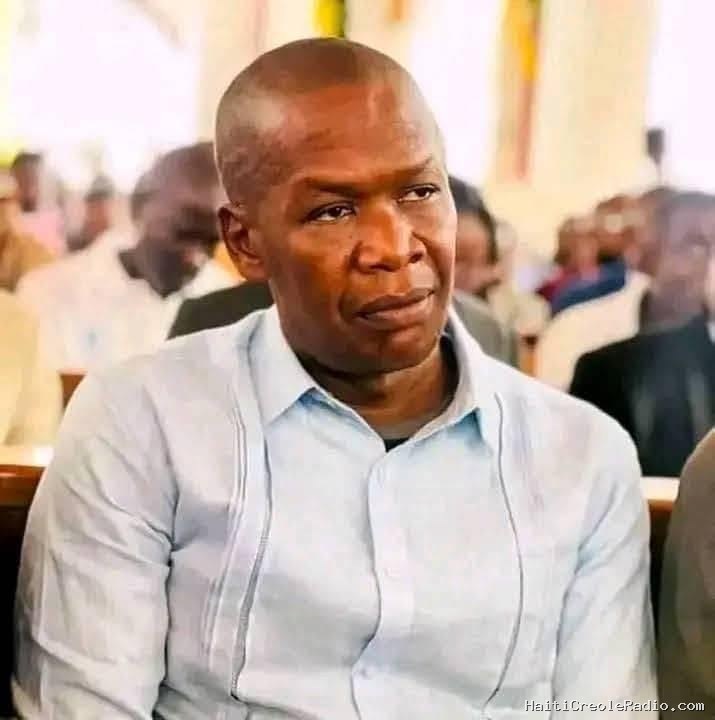
Jean Ernest Muscadin, the Miragoâne public prosecutor, has registered his candidacy for Haiti’s presidency under Fòs Chanjman Nasyonal (FCN), adding one of the country’s most polarizing security figures to a presidential race taking shape amid widespread gang violence and a fragile electoral process.
Muscadin, 63, confirmed his intention to run in September after discussions with FCN— a new party launched last year by sociologist and university professor Auguste D’Meza—which agreed to carry his candidacy. His campaign message has centered on reestablishing security by fighting illegal armed groups and strengthening coordination between the Haitian National Police (PNH) and other security institutions.
His registration listed Wednesday, however, does not mean he has been approved to appear on the final ballot. The Provisional Electoral Council (CEP) says candidate registrations remain preliminary while it reviews submitted documents and handles any challenges—after a validation and appeals process in conformity with a June 2 electoral decree.
According to the electoral calendar, the candidate registration process ends Oct. 10. Under its current schedule, the CEP has set Oct. 14 to publish the definitive list of approved candidates.
If the electoral governing body approves Muscadin’s candidacy, some argue, his presence can bring an unusually direct debate over security, justice and the limits of national and international powers into Haiti’s presidential contest.
Génis Norélia, director general of Florida’s Jacksonville-based Radio Express International, is among those who believe the Miragoâne prosecutor’s candidacy can change the dynamic of the elections— particularly the presidential race, now with 11 confirmed candidates.
“Muscadin’s candidacy might be blocked on technically, but that could force other presidential contenders to explain how they would restore security while maintaining judicial oversight, due process, and accountability,” said Norélia. “It would also put the credibility of Haiti’s electoral institution under scrutiny as the CEP decides whether he meets the legal requirements for participation.”
Under Article 153-16 of the electoral decree, Muscadin should have resigned from his public functions two months before the candidate registration period, which runs from Aug. 20 to Oct. 9. However, as of today, he has not yet made that decision, which could jeopardize his participation in the presidential race.
Muscadin’s public profile and popularity have been built largely on his aggressive response to suspected gang members in Haiti’s southern region, at a time when many Haitians have experienced state failures primarily through its inability to protect communities from criminal armed groups.
At the same time, United Nations human-rights monitors have documented allegations that Muscadin was involved in summary and extrajudicial executions. That combination of public support for his security approach alongside serious human-rights allegations makes his candidacy relevant beyond his individual campaign, as many in Haiti and abroad have long acclaimed him.
Norélia told The Haitian Times that if the CEP approves him, Muscadin can win because people in Haiti are desperate for change. “Many Haitians in the diaspora will support his presidential campaign financially,” he said.
A prosecutor turned political figure with security message
Muscadin became nationally known for his uncompromising approach to suspected gang members in Nippes Department and the wider southern region.
His reputation grew as gangs expanded their operations across Haiti and residents increasingly turned to local self-defense efforts and demanded stronger action from state authorities. Supporters have portrayed Muscadin as an official willing to confront armed groups when other institutions have struggled to protect communities.
That support has been visible in Miragoâne—a coastal town about 60 miles southwest of Port-au-Prince—and elsewhere in the “Grand Sud” or Great South.
In November 2025, thousands of people demonstrated in support of Muscadin after a U.N. human-rights report documented allegations against him. U.S. State Department reporting has likewise noted that local residents supported his tactics and mobilized against efforts to remove him.
Yet, the support has coexisted with sustained criticism from human-rights advocates.
The U.N. said, in its report covering April through June 2025, it documented 27 cases involving Muscadin during that quarter. It added that, since 2022, the Miragoâne prosecutor had been implicated in the deaths of at least 83 people whom he accused of being gang members or committing minor or ordinary crimes.
Muscadin’s political message so far has focused heavily on restoring security.

That message comes as Haiti continues to struggle with the collapse of security across large portions of the country.
The government and the U.N.-backed Gang Suppression Force (GSF) are attempting to expand security operations against armed groups, while communities outside Port-au-Prince have also faced attacks, displacement and efforts by gangs to expand territorial control. The continuing weakness of judicial institutions has made the question of how Haiti restores order — and under whose authority — increasingly central to the country’s political debate.


Commentaires (0)
Laisser un commentaire
Aucun commentaire. Soyez le premier !