Haiti’s Gonaïves keeps World Cup spirit alive with 48th ‘Mundialito’ championship
Teams come from neighborhoods throughout Gonaïves, including Raboteau, Rabeau, Acipha, Seprenne and Lòtbò Kanal. Nearby municipalities in the Artibonite Department, including Gros-Morne, Saint-Michel de l’Attalaye and Anse-Rouge, are also represented. Even the neighboring Northwest Department a
GONAÏVES — The FIFA World Cup 2026 may be over for most across the globe, but in this northern Haitian city— about 93 miles from Port-au-Prince— the soccer celebration continues.
The 48th edition of Gonaïves’ traditional summer league football “Mundialito” began on July 26, bringing 24 teams together for nearly two and a half months of competition. More than a recreational tournament, the event has become an important grassroots platform in a country where organized youth development programs remain limited and inconsistent. It offers athletes — particularly young soccer players outside the federation-affiliated league system — a chance to compete, gain exposure and potentially attract the attention of established Haitian clubs. Mundialito, like many other summer soccer competitions across Haiti, is also a lucrative source of income for many.
The tournament comes as Haiti’s national team returns to the World Cup for the first time since 1974, adding another layer of excitement to a competition that has been part of Gonaïves’ sporting culture for more than five decades.
“The Mundialito represents a sporting heritage for Gonaïves, and this competition must continue for the city,” said Wilsen Desormeau, spokesperson for the organizing committee.
“It is the main championship that provides so much entertainment for the people of Gonaïves and needed exposure to young talent,” he added.
The tournament is organized in a World Cup-style format, with 24 teams divided into two blocks of 12, each consisting of three groups of four teams. The competition is scheduled to run through Oct. 11.
Groups and official calendar of the Mundialito 2026 in Gonaïves, Haiti. Photo Credit: Mundialito organizing committee
Teams come from neighborhoods throughout Gonaïves, including Raboteau, Rabeau, Acipha, Seprenne and Lòtbò Kanal. Nearby municipalities in the Artibonite Department, including Gros-Morne, Saint-Michel de l’Attalaye and Anse-Rouge, are also represented. Even the neighboring Northwest Department also features a representative in the championship through Tabasco, a club from Jean-Rabel.
Among the participants are clubs, with some names more colorful than others in different languages, such as Bijou F.C., the defending champion; Los Tecnicos F.C.; Brooklyn & Lib F.C.; Vapor F.C.; Belle Etoile; Rêve d’Or F.C.; Prestige F.C.; Damballah F.C.; Free Cool Star; Calcio F.C.; and TEAM Asosye.
Each team paid a registration fee of 100,000 gourdes, approximately $770, Desormeau said.
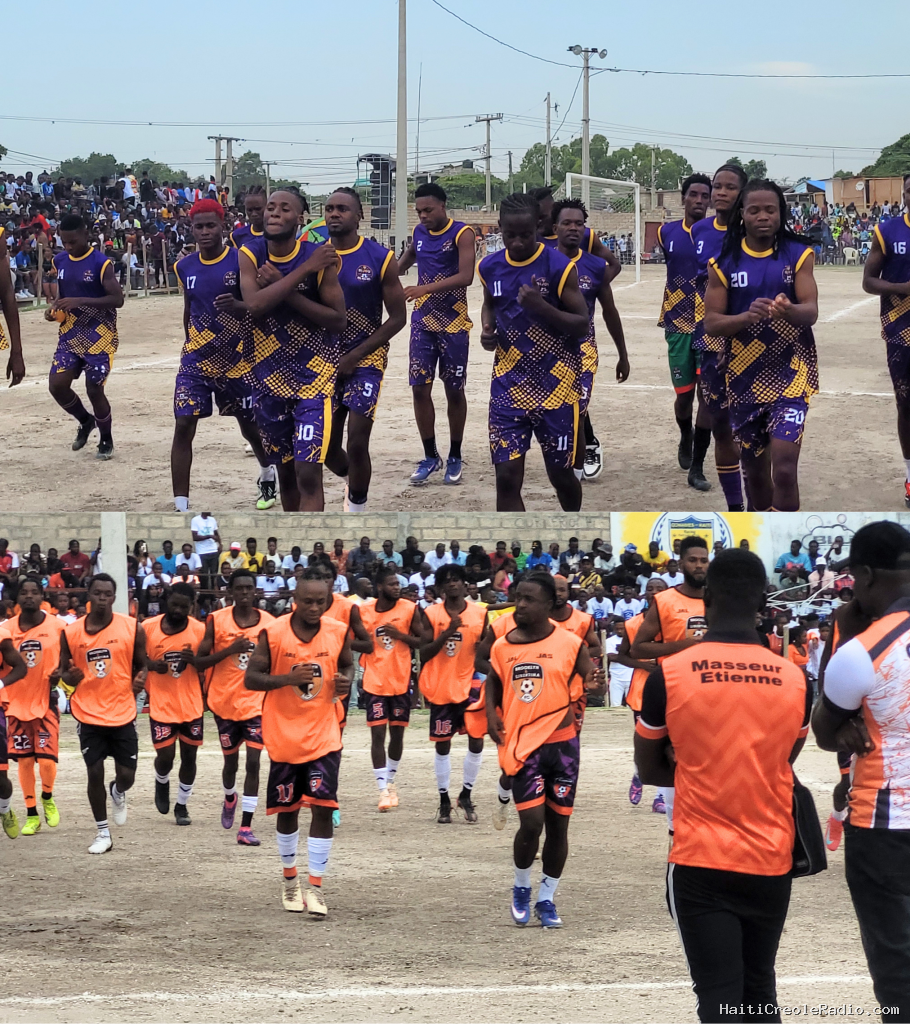
The opening ceremony began July 24 with a thanksgiving Mass at Saint Charles Borromeo Cathedral, followed by a parade through the city featuring players, teams, and members of the Gonaïves City Support Committee (COSIVIGO) and the Youth Football Revival Committee (COREFOJE).
A grassroots pipeline for young talent
The senior tournament is running alongside a separate competition involving 12 Under-16 teams. Organizers describe the youth tournament as both a showcase and an opportunity for players to attract the attention of established clubs affiliated with the Haitian Football Federation (FHF), the country’s soccer governing body.
That role is particularly important in Haiti, Desormeau said, where many young players have few reliable avenues to train, compete regularly and be evaluated by professional or established clubs.
Summer leagues such as the Mundialito can therefore serve as informal scouting networks. Players from neighborhoods and smaller communities who might otherwise remain outside Haiti’s formal development structure can compete before local coaches, club officials and larger audiences.
For many observers, the youth competition also reflects the broader role that soccer plays in Haitian communities: providing recreation while creating opportunities for young people to develop skills, build connections and pursue a path in the sport.
$10,000 prize for the champion, teams set sights on the title
The winning club will receive 1.25 million gourdes, or about $9,615, plus a trophy and medals. The runner-up will receive 500,000 gourdes, or about $4,000. Individual prizes and trophies will also be awarded to top players and goalkeepers.
The tournament’s organizing committee estimates its overall budget at between 6 million and 7 million gourdes, or roughly $46,000 to $54,000. Funding comes primarily from contributions by committee members, sponsors in Haiti and the diaspora and registration fees.
Ticket and advertising revenue is divided among the organizers, participating teams, the Ministry of Youth, Sports and Civic Action and Gonaïves City Hall.
About 70% of the revenue goes toward organizing the tournament, while the remaining 30% is distributed among participating teams and institutional partners, Desormeau said.
With the championship underway, club leaders and supporters are already predicting a title run.
Evens Jean, manager of Los Tecnicos F.C., said his team hopes to repeat its 2022 championship win.
“We want to relive what we accomplished in 2022,” Jean said. “We are ready to become Mundialito champions again.”
Jordany Stérile, president of Brooklyn & Lib F.C., also has his sights on the trophy after his team lost last year’s final to Bijou. F.C.
“The Mundialito represents a sporting heritage for Gonaïves, and this competition must continue for the city.”
Wilsen Desormeau, spokesperson for the Championship
“We are determined to win this competition,” Stérile said. “We are among the best teams in the tournament, and we want to lift the trophy this year.”
Fans from clubs including Bijou, Tabasco and Los Tecnicos joined the opening parade, bringing color and enthusiasm to the start of the tournament.
The Jean-Rabel team Tabasco, competing in the championship for the first time, has no intention of simply participating, supporters said. Bijou fans from the Acipha neighborhood also turned out in purple and yellow to support the defending champions.
A tradition born in Raboteau
Mundialito traces its origins to Raboteau, a densely populated coastal neighborhood of Gonaïves that has long endured poverty, political violence and human rights abuses.
The tournament was launched through the initiative of the city’s resident Antoinette “Tisò” Jean-Louis, the mother of civil engineer Jacky Jean Noël, who now serves as president of both the organizing committee and COSIVIGO.
According to organizers, the competition has been held annually since Haiti’s participation in the 1974 World Cup. More than five decades later, it remains one of Gonaïves’ defining sporting traditions.
The tournament is normally played at the Savane Poudrière field, located behind the city’s police headquarters. This year, however, organizers moved the matches to Parc Vincent—Gonaïves’ main soccer ground—because rehabilitation work at Savane Poudrière was not completed in time.
“We were forced to start the competition at Parc Vincent to avoid further delays,” Desormeau said.
COSIVIGO members say they have invested in improving the Savane Poudrière field for more than three years, despite limited resources.
“Gonaïves has suffered from a lack of adequate sports infrastructure for several years,” Desormeau lamented.
Parc Vincent itself has a dirt field that falls short of modern soccer standards, reflecting a broader shortage of quality playing facilities across Haiti.
Effort underway to rebuild Parc Vincent
A separate reconstruction project is now being developed for Parc Vincent, with an estimated cost of about $250,000.
Local entrepreneur Anderson “PAPAYO” Despinasse has pledged $20,000 toward the project, while former Artibonite Sen. Youri Latortue has promised $50,000, according to local reports.
The proposed reconstruction committee would be led by Pastor Job Fenelon, with AGOM responsible for general coordination. Engineers, architects and sports technicians would serve on a technical committee, while a finance and oversight committee would oversee auditing and public reporting.
About $130,000 of the proposed budget would go toward grading, drainage and installation of artificial turf. Another $110,000 would cover lighting, locker rooms, restrooms, bleachers, a sound system, scoreboard and other improvements.
For organizers, improving the city’s sports infrastructure is about more than creating a better venue for the Mundialito. It could also give Gonaïves’ young athletes a more reliable place to train, compete and be seen.
For a city that has kept its summer soccer tradition alive for more than 50 years, the tournament’s continued appeal may ultimately depend on whether Haiti can build the facilities and development pathways needed to turn that tradition into lasting opportunities for the next generation of players.
Related
Onès Joseph is an experienced journalist with over 16 years in the field. He began his journalism training at Vision R+ Journalism School in Port-au-Prince and holds a bachelor's degree in computerized accounting from Julien Crâne in Gonaïves. Onès has enhanced his skills through seminars and training by prestigious organizations such as UNESCO, the Haitian Journalist Association, and Panos Caribbean.
His extensive career includes contributions to numerous respected media outlets, including Solidarity Radio, Signal FM, and Radio Classique FM, among others. Onès' broad experience highlights his commitment and expertise in journalism.




Commentaires (0)
Laisser un commentaire
Aucun commentaire. Soyez le premier !