
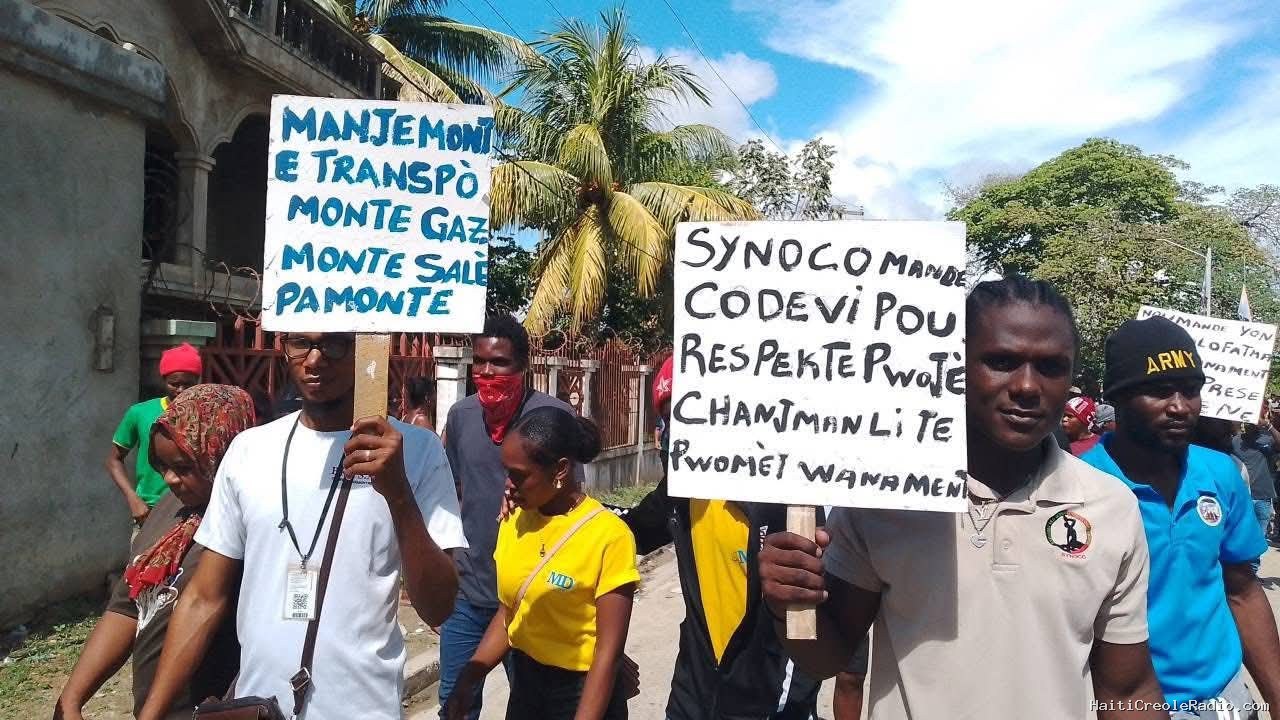
OUANAMINTHE, Haiti — Textile workers in northeast Haiti have rejected the government’s newly offered minimum wage, saying it does not reflect the rising cost of living and vowing to continue their strike.
The May 4 minimum wage increase announced by Minister of Economy and Finance Gabriel Colin has failed to ease tensions at the CODEVI industrial park — a duty-free zone on the border with the Dominican Republic — where thousands of workers have mobilized since April. Workers who produce apparel, T-shirts and knit goods for export, primarily to the United States, are demanding a daily wage of 3,000 gourdes, or roughly $23. They argue the government’s increase — which added about $2.40 to the pre-strike daily wage, raising it to $7.70 — no longer meets basic needs.
“One thousand gourdes [$7.70] is nothing compared to the cost of living. We are demanding 3,000 gourdes [$23] after 10 years without a meaningful pay increase,” said Denise Joseph, a worker at the Group M2 factory.
“We work hard every day, but our wages no longer allow us to live with dignity,” added Phara Louis, a mother of two.
The textile sector remains one of Haiti’s last major formal industries and among the country’s largest private-sector employers. The apparel industry generates hundreds of millions of dollars annually in exports, primarily to the United States, and supports tens of thousands of jobs directly and indirectly.
Much of the sector’s survival depends on U.S. trade preference programs known as HOPE and HELP, which allow qualifying Haitian textile and apparel products to enter the U.S. market duty-free. The programs were recently extended through the end of 2026 after briefly lapsing in late 2025, a disruption that created uncertainty for manufacturers and investors.
According toU.S. trade data and industry groups, Haiti’s garment exports to the U.S. generated roughly $844 million in 2023, accounting for the overwhelming majority of the country’s exports.
Yet, despite the extension of the trade preference programs, boosting investors’ confidence, industry advocates warn that Haiti’s apparel sector could collapse under struggles over minimum wage increase, mounting insecurity and transportation costs.
Mackenley Jean-Baptiste, a production worker at the CODEVI complex, questioned the value of the minimum wage increase introduced by the administration of Prime Minister Alix Didier Fils-Aimé. “How can 1,000 gourdes make a difference when a gallon of gasoline, a basic consumer necessity, costs 850 gourdes?” he said.

Economic ripple effects amid longstanding grievances
The wage dispute is unfolding amid prolonged economic deterioration in Haiti. Inflation has remained persistently high in recent years, sharply reducing purchasing power for low-income workers, while the gourde has continued to lose value against the U.S. dollar.
Fuel prices and transportation costshave become central grievances for workers, many of whom spend a substantial portion of their daily earnings commuting to factories or buying basic necessities. Protesters argue that wages have failed to keep pace with inflation despite repeated increases in living costs.
The crisis exposes the fragility of Haiti’s export-led assembly model, which depends heavily on low-wage labor and preferential U.S. market access while operating in an environment plagued by gang violence, political instability and crumbling infrastructure.
Factory owners and business groups argue that higher wages could further strain an industry already struggling with insecurity, shipping disruptions and competition from lower-cost manufacturing hubs elsewhere in the Caribbean and Central America.
However, CODEVI’s Human Resources Manager, Lesly Périsse, told The Haitian Times that wage increases in the sector depend on the Haitian government.
“The responsibility for increasing the minimum wage falls under the state’s purview,” he said.
The strike is reverberating beyond factory gates.
“How can 1,000 gourdes per day be worth it when a gallon of gasoline, a staple consumer good, costs 850 gourdes?”
Mackenley Jean-Baptiste, Striking Worker
CODEVI, a major textile manufacturing hub, is a key economic engine for the region. The slowdown is affecting thousands of livelihoods tied to the industrial park operations.
Small merchants, motorcycle taxi drivers and street vendors report declining income as activities have been paralyzed due to the labor protests.
“Every day without work is a loss for us,” said Lucknel Joazard, a motorcycle taxi driver who operates near the industrial park.
Worker protests over wages are not new in Haiti, but the latest mobilization reflects growing frustration as inflation further erodes purchasing power.
Since 2022, textile workers’ minimum daily wage had remained around 685 gourdes before the latest adjustment, even as inflation and transportation costs surged. Rising fuel prices — now exceeding a day’s wages — have driven up commute and food costs, further straining household budgets. A situation textile workers say reflects deeper structural issues in Haiti’s economy, where salaries have not kept pace with inflation.
“We can work an entire week and still struggle to feed ourselves,” said Josenie Pierre at the Group M2 factory.


Commentaires (0)
Laisser un commentaire
Aucun commentaire. Soyez le premier !