
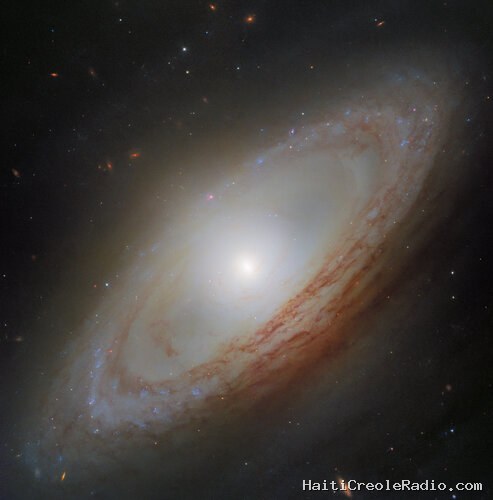
Though the spiral galaxy in this new image by the NASA/ESA Hubble Space Telescope seems serene, it hides a chaotic secret. This galaxy is NGC 4698, and it lies about 55 million light-years away in the constellation Virgo. It’s one of over one thousand galaxies in the Virgo Cluster, the nearest large cluster of galaxies bound together by gravity.
As a spiral galaxy similar to our own Milky Way galaxy, NGC 4698 has spiral arms that curl around within a thin disc of stars, gas and dust. Its centre is dominated by a galactic bulge.
The diffuse off-white glow of the galaxy’s bulge comes from stars smaller, older, and cooler than the massive blue stars that dot the galaxy’s outer disc. These tightly packed stars orbit a supermassive black hole containing millions of times the Sun’s mass. Scientists have found signs that this black hole is actively growing, drawing gas inward with its gravitational pull.
With a flat, starry disc and diffusely glowing centre, NGC 4698 looks a lot like a typical spiral galaxy — but this galaxy is far from normal. NGC 4698 is one of only a few known spiral galaxies with a bulge that extends out from the disc at a right angle. The elongation is faintly visible in this Hubble image, which shows the ghostly glow of the starry bulge peeking above and below the dusty disc. What’s more, the stars and gas nearest the galaxy’s centre rotate perpendicular to the rest of the disc.
What could cause a galaxy to be so out of sync? Astronomers have found that the culprit likely lies outside the galaxy. If NGC 4698 funneled in gas from an outside source, the newly collected gas could have formed a disc of gas and stars in the galaxy’s centre, at an angle relative to the rest of the disc. Some observations suggest that this galaxy once experienced a minor galactic merger, as evidenced by a short ‘tail’ of hydrogen streaming from one side of the galaxy.
The data used to create this image come from an observing programme (#18103; PI: Thilker) focusing on galaxies in the Virgo Cluster.
[Image Description: A spiral galaxy viewed at an angle, with a bright central bulge and winding spiral arms. The arms form a ring around the galaxy, without appearing to reach its centre. Prominent red-brown dust lanes weave through the arms, which are also dotted with bright blue and reddish regions of star formation. The galaxy is set against a dark background scattered with stars and faint distant galaxies.]



Commentaires (0)
Laisser un commentaire
Aucun commentaire. Soyez le premier !