
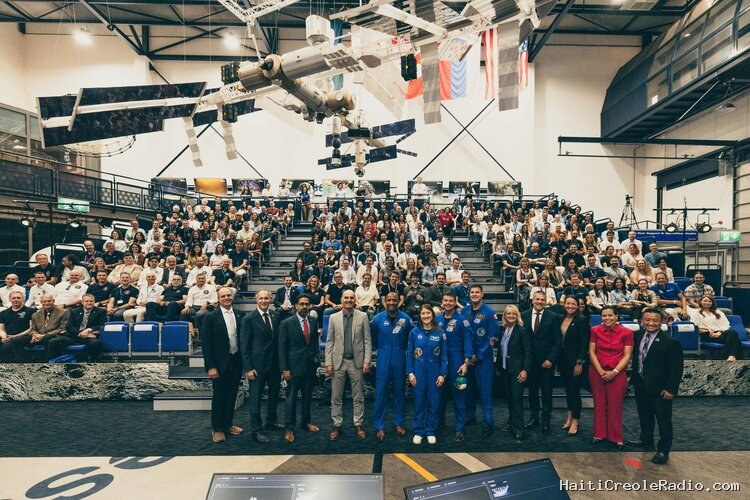
Yesterday, the four Artemis II astronauts visited ESA’s technical site in the Netherlands, where they met the team behind the European Service Module that powered their Orion spacecraft around the Moon and safely back to Earth.
NASA astronauts Reid Wiseman, Victor Glover and Christina Koch, and Canadian Space Agency astronaut Jeremy Hansen were joined by NASA Associate Administrator Amit Kshatriya and NASA’s Orion Program management for this first stop of post-flight visits to the European teams that supported the Artemis II mission. Later this week, they will also visit European Service Module prime contractor Airbus in Bremen, Germany, and Thales Alenia Space in Turin, Italy, who built the module's structure.
The day began with a tour of ESA's exploration facilities at ESTEC, visiting the Eagle mission control room, where engineers monitored the European Service Module around the clock throughout Artemis II and worked closely with teams at NASA’s Johnson Space Center in Houston.
The astronauts also visited the Human-Robot Interaction Lab, where robotics engineers are developing technologies for future lunar and martian exploration.
The visit included a recognition event during which NASA Orion Program Manager Howard Hu presented ESA with a Program Award and certificates acknowledging the important European contribution to the mission.
In the afternoon, the astronauts participated in a press conference, including ESA Director of Human and Robotic Exploration Daniel Neuenschwander, US ambassador to the Netherlands Joseph Popolo and Canadian Ambassador to the Netherlands Hugh Adsett on-site, as well as ESA Director General Josef Aschbacher joining remotely. The day ended with an informal gathering with ESA’s European Service Module team and their families.
The Artemis II mission launched on 1 April and lasted 10 days, carrying humans around the Moon for the first time since Apollo 17 in 1972. Throughout the journey, ESA’s European Service Module supplied air and water for the crew, maintained thermal control, generated electrical power through its four solar arrays and provided the propulsion needed to travel more than one million kilometres through deep space. Built by European industry under ESA leadership and assembled by Airbus in Bremen, the module brings together expertise from 13 European countries.
Following successful flights on Artemis I and Artemis II, Europe has already delivered for the next mission. The third European Service Module arrived at NASA’s Kennedy Space Center in 2024 and will soon be connected to the crew module to form the Orion spacecraft for Artemis III. The mission will include ESA astronaut Luca Parmitano as pilot, who will become the first European to fly an Artemis mission.


Commentaires (0)
Laisser un commentaire
Aucun commentaire. Soyez le premier !