
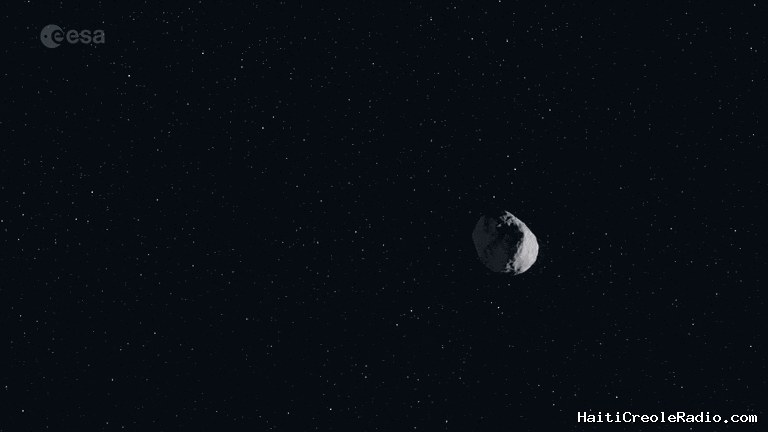
Happy Asteroid Day! Today is the annual UN-recognised global event to promote public education on asteroids and planetary defence. But why today, of all days? Read on to find out – and find out the other key dates in our current golden age of asteroids!
Once considered by 19th century astronomers as ‘vermin of the sky’ for their tendency to creep across long exposures, asteroids are leftover objects from the creation of the Solar System. The vast majority of them are located within the Asteroid Belt between Mars and Jupiter, but also found elsewhere – including near-Earth asteroids with the potential to strike Earth.
30 June 1908 – Siberian airburst
Asteroid Day marks the largest asteroid detonation witnessed by modern humans, which took place on this morning, up to 10 km above the vicinity of the Podkamennaya Tunguska River, in a fortunately sparsely-populated province of Siberia. An incoming object exploded, resulting in a 3-5 megaton airburst.
This ‘Tunguska event’ toppled around 60 million trees across 2200 sq km of territory, with a dead but upright ‘telegraph forest’ of tree trunks remaining at the airburst epicentre. It struck only a short rotation of Earth away from Europe – the results would have been disastrous over a populated area.
As it was, Europe was indirectly touched by Tunguska, with atmospheric pressure waves and seismic tremors recorded and ‘strange illumination’ in the night sky.
Despite the titanic nature of the Tunguska explosion it took more than a decade for the site to be investigated, although the damage done by the event remained unmistakable.
21 October 1991 – First asteroid encounter
Similarly, it was well into the Space Age before the first asteroid was visited by a spacecraft: NASA’s Galileo mission passed 1600 km away from the Gaspra asteroid on its way to Jupiter.
Beforehand, astronomers observing through telescopes thought asteroids might simply be unchanging chunks of rock, but the images of the 12-km-diameter Gaspra shows that they are in fact complex geological worlds in their own right, with very irregular shapes and abundant geological features.
The stony asteroid’s irregular shape, sharp edges and plentiful grooves – probably evidence of fractures – suggested it was the product of one or more collisions. It also had a striking abundance of small craters, much greater than on other bodies and also showed evidence of landslides, despite Gaspra’s extremely low gravity. In short, asteroids turned out to be much more dynamic places than anyone had previously imagined.
Galileo went on to visit a second asteroid, Ida, in 1993, where it made the discovery the asteroid had its own moon orbiting it, Dactyl. Today we know about 15% of the 1.4 million asteroids discovered to date are ‘binary’ in nature, possessing one (or some cases two or even three) moons.
12 February 2001 – landing on an asteroid
Many asteroids have made it to Earth, based on the geological record, but this date was the first time a little piece of Earth settled down on an asteroid.
NASA’s NEAR (Near Earth Asteroid Rendezvous) Shoemaker spacecraft spent more than a year surveying the peanut-shaped 433 Eros, a near-Earth asteroid whose orbit brings it close to our planet. Its survey revealed a surprisingly rich surface – featuring craters, dust ponds and house-size boulders.
Then came the end of mission: on 12 February controllers performed the first spacecraft touchdown on an asteroid – the spacecraft transmitted 69 close-up images during its final descent and continued to operate for another 16 days after landing.
5 September 2008 – Rosetta’s asteroid flyby
Europe’s first close encounter with an asteroid took place as ESA’s Rosetta spacecraft passed the Šteins asteroid on the way to Comet 67P/Churyumov–Gerasimenko.
This Gibraltar-sized diamond-shaped body turned out to be scarred by dozens of impact craters, including one gaping hole at its south pole – a large impact crater about 2 km wide and nearly 300 m deep.
A second close encounter took place in 2010, as Rosetta passed the mammoth 100 km-diameter Lutetia – some 250 times bigger than Rosetta’s target comet – which is also heavily cratered. It fast became clear that collisions are fundamental to the nature and history of asteroids, and by extension the entire Solar System.
13 June 2010 – asteroid sample return
Launched in 2003, Japan’s Hayabusa mission had the ambitious goal of returning material to Earth from potato-shaped 330-m-diameter asteroid Itokawa.
Named for the Japanese for ‘falcon’, Hayabusa was a near crippled spacecraft by the time it reached its destination. Blasted by a solar flare, controllers were reduced to relying on one reaction wheel and two chemical thrusters to maintain attitude control as the spacecraft made repeated touchdowns onto the asteroid’s surface to gather material.
Hayabusa was bedeviled by leaky thrusters, communication blackouts and a small lander that failed to land, instead drifting off into space – demonstrating the challenge of operating in asteroid gravity.
Even so, Hayabusa detached its re-entry capsule at a distance of about 300 000 to 400 000 km from Earth, allowing the capsule to coast on a ballistic trajectory until it reentered Earth's atmosphere. The capsule experienced peak deceleration of about 25 G and heating rates approximately 30 times those experienced by the Apollo spacecraft. It landed via parachute near Woomera, Australia, on 13 June 2010.
Within it turned out to be an extremely small amount of asteroid material – only about 1,500 microscopic dust grains – but scientifically priceless. Several grains were lent to ESA for analysis.
On a parallel trajectory, Hayabusa itself burnt up in the atmosphere. But successor spacecraft Hayabusa2 succeeded in returning 5.4 grams of material from the primitive ‘carbonaceous’ asteroid Ryugu in 2020 while NASA’s OSIRIS-Rex mission also brought back material from asteroid Bennu.
Both missions remain operational: Hayabusa2 is about to perform a flyby of asteroid Torifune next week while OSIRIS-Rex (renamed OSIRIS-APEX) is due to rendezvous with the Apophis asteroid in 2029 (see below).
15 February 2013 – Invisible impactor
No one saw the Chelyabinsk meteor coming. Just after sunrise on a calm and sunny winter’s day, a 20-metre asteroid struck the atmosphere over the Ural Mountains in Russia, at a speed of more than 18 km/s.
The relatively small rock approached Earth from very near the direction of the Sun, exploding in the atmosphere and creating a shockwave that damaged thousands of buildings, breaking windows and injuring roughly 1500 people from flying shards of glass. It was the largest asteroid to strike Earth since Tunguska.
Working with NASA’s Sentry system and astronomers around the globe, ESA’s Near-Earth Coordination Centre monitors and evaluates the threat posed by bodies that come near Earth. But asteroids like the Chelyabinsk impactor coming out of the Sun are largely invisible to current survey methods.
A new ESA mission proposal called NEOMIR seeks to plug this blind spot, through the use of infrared vision to pick out bodies 20 m and larger that cannot otherwise be seen.
26 September 2022 – Impacting an asteroid
If an asteroid was found heading to Earth, what could be done to stop it? NASA’s Double Asteroid Redirect Test, DART, formed the first part of an ambitious international experiment to find out.
The vending-machine-sized spacecraft impacted the 151-m Dimorphos asteroid at a speed of 6.1 km/s. The aim was to change its orbit around parent asteroid Didymos - which it rotates around like the Moon around Earth - to test the ‘kinetic impact’ method of planetary defence.
The test succeeded: the 11 hour 55 minutes orbit of Dimorphos around Didymos was shortened by about 33 minutes, making it the first object in our Solar System to have its orbit measurably changed by human action.
25 November 2026 – Here comes Hera
DART’s impact was observed across Earth, as the dust and debris it liberated caused Dimorphos to brighten more than tenfold. But many unknowns remain, including the precise structure and mass of Dimorphos, and how the impact changed the small body. Has it been left with a massive crater, or reshaped entirely by the force of collision?
Launched in October 2024, ESA’s Hera mission is designed to find out, equipped with an ‘Asteroid deck’ of instruments plus two shoebox-sized CubeSats to fly closer to the asteroid’s surface than their van-sized mothership.
The data returned by Hera – starting with the first image of the transformed Dimorphos unveiled on 25 November – should let researchers turn the kinetic impact method into a well-understood and customable method of planetary defence, should we ever need it for real.
13 April 2029 – Apophis day
A future red letter day for asteroids, when the cruise-liner-sized Apophis asteroid passes will pass less than 32 000 km from Earth’s surface, visible to the naked eye for more than two billion people across parts of Europe, Africa and Asia.
Coming ten times closer to Earth than the Moon, and many satellites, scientists believe that – while there is zero risk of any impact now or in the conceivable future – our planet’s gravity could have dramatic effects on Apophis.
The Rapid Apophis Mission for Space Safety (Ramses) under construction by ESA and the Japan Aerospace Exploration Agency (JAXA) aims to rendezvous with Apophis and accompany the asteroid during the flyby to observe how it is warped and changed by our planet’s gravity – a free experiment offering insight into the internal structure of asteroids, in support of planetary defence.
Ramses will be completed in spring next year then undergo testing at ESA’s ESTEC technical centre in the Netherlands before being launched by Japanese H3 rocket in spring 2028, along with JAXA’s DESTINY + mission which will also perform a preliminary flyby of Apophis.
2029: International year of asteroid awareness and planetary defence
In recognition of the potential of this flyby for public education, the United Nations has designated 2029 as the international year of asteroid awareness and planetary defence – find out more about Asteroids2029 here.

Commentaires (0)
Laisser un commentaire
Aucun commentaire. Soyez le premier !