
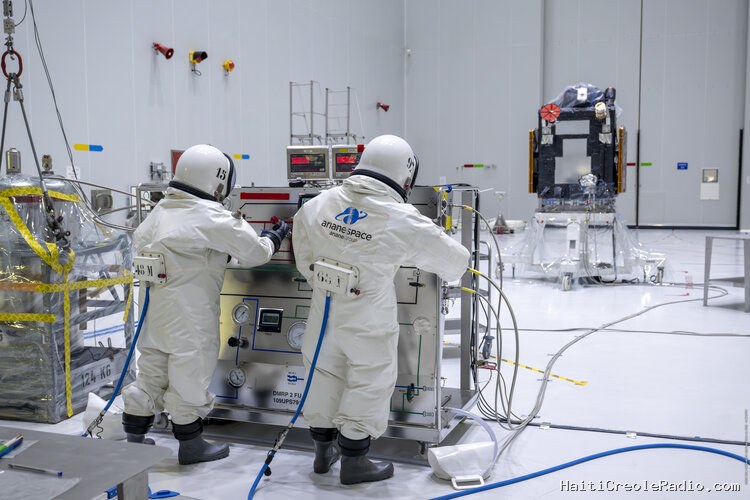
Europe’s newest eye on the health of Earth’s vegetation has taken another crucial step towards orbit – the European Space Agency’s FLEX satellite has been fuelled at Europe’s Spaceport in French Guiana ahead of its planned launch on 15 September at 03:21 CEST (14 September at 22:21 local time).
Once launched and commissioned, this latest ESA Earth Explorer research satellite, equipped with its Fluorescence Imaging Spectrometer, will provide new insights into the health of the world’s plants by measuring the faint glow of fluorescence emitted as they capture light for photosynthesis.
This signal, invisible to the naked eye, varies with environmental conditions and plant health, enabling scientists to detect vegetation stress before it becomes apparent on the ground.
FLEX will deliver the first global maps of vegetation fluorescence at a spatial resolution of 300 m × 300 m, providing a new way to assess photosynthetic activity. These data will improve understanding of how carbon moves between plants and the atmosphere, and how photosynthesis drives the carbon and water cycles.
The stakes are high. Photosynthesis is one of the planet’s most important natural processes, underpinning food production and absorbing huge quantities of carbon dioxide from the atmosphere. Yet scientists still have significant gaps in their understanding of how vegetation responds to drought, heat, changing rainfall and other environmental stresses.
FLEX is intended to help close that gap.
The FLEX satellite arrived in French Guiana in mid-July, together with the Copernicus Sentinel-3C satellite, after a two-week voyage by sea from Nice, France. At Europe’s Spaceport, engineers have been carrying out inspections and preparations to ready both satellites for liftoff aboard a Vega-C rocket in the early hours of 15 September.
For FLEX, the latest milestone was the hazardous and delicate process of loading the satellite with 30 kg of highly volatile fuel. This propellant will allow FLEX to perform manoeuvres after separation from the rocket and throughout its planned minimum 3.5-year mission, during which it will observe at least three seasonal vegetation cycles in both the northern and southern hemispheres.
Fuelling is an extremely hazardous operation and takes place under strict safety procedures, carried out by a highly specialised team.
Frank de Bruin, ESA’s Launch Campaign Manager for FLEX, said, “Preparations to ready our satellite for launch have been going very well here at Europe’s Spaceport and I thank everyone involved. For fuelling, everyone apart from the fuelling experts left the cleanroom for safety reasons. Everything went according to plan and FLEX is now fully loaded. The next steps involve installing FLEX on its launcher adapter before encapsulating it into lower position of the Vega-C rocket fairing.”
Although FLEX and Sentinel-3C will be launched together, FLEX will initially fly in tandem with the Sentinel-3A satellite. This will provide complementary measurements of clouds, aerosols and water vapour, alongside information about the land surface, including surface temperature, land-cover type and additional vegetation parameters. Together, these near-simultaneous observations will provide an unprecedented view of the function and condition of vegetation across the globe.


Access the video
After years of design, construction and testing, and with now its fuel tanks now filled, FLEX is almost ready to fly.



Commentaires (0)
Laisser un commentaire
Aucun commentaire. Soyez le premier !