
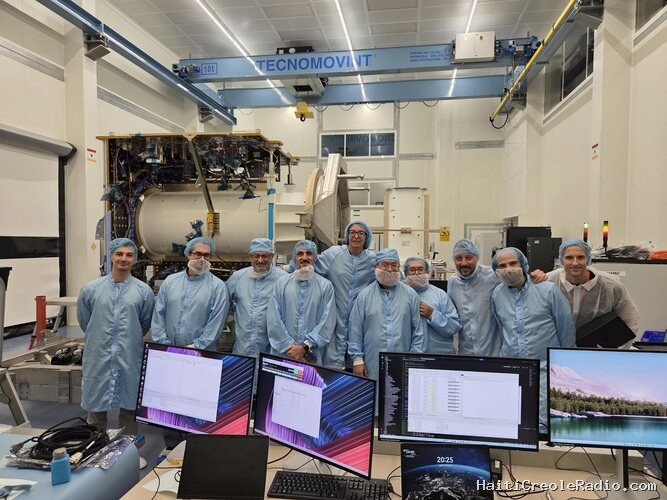
The European Space Agency’s and Japan Aerospace Exploration Agency’s Ramses planetary defence spacecraft has been turned on for the first time by its prime contractor – marking a major milestone in its time-critical development schedule.
Ramses must reach space by spring 2028 in order to rendezvous with the cruise-liner-sized Apophis asteroid as it passes Earth on Friday 13 April 2029, representing less than three and a half years from contract signing to lift-off.
The spacecraft’s Core Module, containing all its main electronics, is currently being assembled in the Milan cleanroom facility of OHB Italia. Key Ramses units have been mounted within the module’s U-shaped body, and then linked together via intricate cabling, known as the spacecraft harness.
“For the first time we were able to apply power to Ramses’s On-Board Computer together with its integrated subsystems inside the spacecraft body,” explains Ramses lead engineer Ingo Gerth.
“Obviously these units have previously undergone individual testing, but this was by themselves in a void. Now, for the first time we have been able to perform real integrated functional testing, working in unison with other equipment on the satellite. We can now send commands via the computer to each subsystem to verify their performance.”
Along, with the On-Board Computer, these integrated subsystems include the mission’s Mass Memory Unit for data storage, the Power Conditioning and Distribution Unit – delivering power throughout the spacecraft – and multiple Remote Terminal Units, converting outputs from instruments into digital data for the computer.
The installation of the units and connecting harness was performed by specialist OHB Italia teams, working hard to maintain the rigorous Ramses mission schedule.
Ramses functional architect Arnaud Bourdoux comments: “This first spacecraft switch on was a very exciting moment for us all, because these are the same system-critical units we will be turning on when Ramses is there on its launch pad, to start its actual journey into space.”
Guiseppe Filomeno, Ramses project manager at OHB Italia, adds: “This first integrated switch-on marks an important milestone for Ramses, as the spacecraft begins to come to life at our facilities in Milan. Powering up the onboard computer and establishing communication between the connected units provides the first tangible confirmation that the integrated systems are working together as intended.”
ESA’s Ramses project manager Paolo Martino explains: “This moment really marks a completely new phase for the project; everything beforehand was just paper calculations, simulations or unit tests, but now we have an actual spacecraft, ready for our full-scale integrated system testing to begin.”
To save further schedule time, Ramses is being assembled in two parts at once. The Core Module in Italy is being built around a dummy version of the spacecraft’s central cylindrical core.
Meanwhile the spacecraft’s Propulsion Module – including its actual carbon-fibre reinforced-polymer core – is currently being dressed with propellant tanks, associated sensors, actuators, and linking harness at ArianeGroup’s Orbital Propulsion Centre in Lampoldshausen, Germany.
The two modules will be mated together next spring at ESA’s ESTEC Test Centre in Noordwijk, the Netherlands, which will mark the start of its pre-flight testing phase.
“The testing will reproduce all the conditions Ramses will go through during its launch and operations in space,” notes Franco Perez Lissi, system engineer for Ramses at ESA.
“Among the most challenging will be its thermal vacuum test, where the complete spacecraft will be placed in space-quality vacuum for two to three weeks and operated on a continuous basis. Equally difficult will be its mission simulation test involving Ramses going through a sped-up simulation of everything from lift-off to its end of mission.”
The ESA-JAXA Ramses mission – and its two accompanying CubeSats – must be ready to be launched on a Japanese H-3 rocket in spring 2028.


Access the video

Commentaires (0)
Laisser un commentaire
Aucun commentaire. Soyez le premier !