
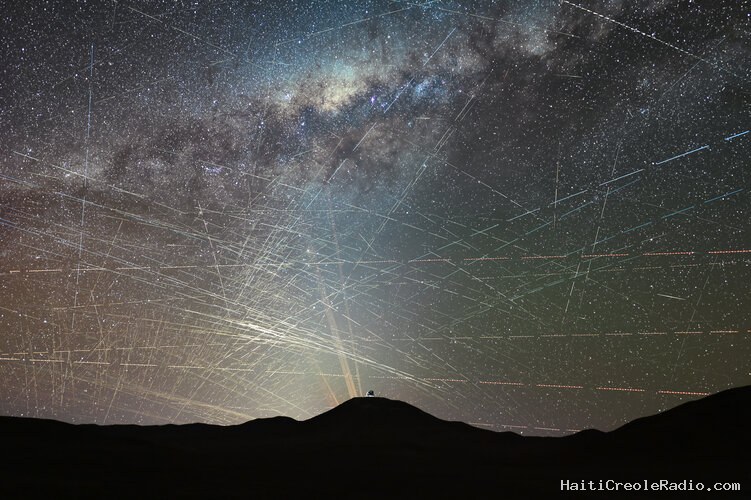
For thousands of years, the night sky has inspired humanity, guided explorers and helped scientists unlock the mysteries of the Universe. As the number of satellites in orbit grows, their reflected light and radio frequency interference become a challenge for both professional astronomy and simple stargazing.
The European Space Agency (ESA) and the International Astronomical Union’s Centre for the Protection of the Dark and Quiet Sky (IAU CPS) have signed an agreement at the International Astronautical Congress to strengthen cooperation and develop technical solutions to keep the sky dark and quiet.
“This collaboration marks an important step towards a future where valuable astronomical observations and other space activities can coexist, allowing scientists to continue exploring the cosmos while future generations can still enjoy an unobstructed view of the stars,” says Rolf Densing, Director of Operations at ESA.
“We think that space can be used responsibly while preserving humanity’s access to the night sky. Together with IAU CPS we can work on technological solutions that work for industry, science and all of us who enjoy looking up at an unpolluted night sky.”
Disrupting observations
The industrialisation of low-Earth orbit with the rapid growth of satellite constellations is creating unintended impacts on astronomy. Most people have seen satellites streaking across the sky in the hours after sunset: bright dots that move faster than any plane could.
“These satellites threaten scientific discoveries across the electromagnetic spectrum. Satellites can reflect sunlight, creating bright streaks across telescope images and disrupting observations of faint and distant signal sources. At the same time, electronic systems onboard spacecraft can generate unintended radio emissions that interfere with sensitive radio telescopes,” says Jan Siminski, space debris analyst at ESA.
“Astronomers rely on uninterrupted observations to study the origins of the Universe, search for potentially habitable worlds and track near-Earth asteroids that could pose a hazard to our planet. It is crucial that we find ways to prevent interference.”
Aside from such practical applications, the night sky also represents a shared cultural and natural heritage. People around the world have looked up in wonder at the stars throughout the ages.
There are also many animal species that depend on natural night-time conditions for navigation, making preservation of dark skies important if we are to protect the natural environment.
Design for darkness
Keeping the sky dark and quiet starts long before a satellite reaches orbit. It begins at the design stage, where engineers can make choices that limit unwanted reflections and radio emissions.
“Space agencies, researchers and industry need to combine their expertise in order to create satellites that can be much less disruptive. We need to develop new technologies, materials and best practices that help satellites coexist more harmoniously with astronomical observations,” says Jan.
“It is a whole range of efforts that include creating darker spacecraft surfaces and radio-quiet electronics as well as models that help engineers understand how their satellites will appear to telescopes on Earth.”
Collaboration with CPS
By signing this Memorandum of Intent, ESA and the IAU Centre for the Protection of the Dark and Quiet Sky (IAU CPS) are combining their strengths to protect the night sky.
The IAU CPS brings together astronomical institutions, observatories, researchers, companies and citizens committed to raising awareness of the impact of satellite interference on astronomy.
ESA will contribute its technical expertise and strengthen engagement with industry to develop practical solutions that reduce the impact of satellites on astronomical observations.
“Together, ESA and the CPS will foster dialogue between astronomers and satellite operators, support the development of new technologies and promote best practices for dark and quiet skies,” says Piero Benvenuti, Director of IAU CPS.
“The partnership’s shared commitment balances the growing use of space with the preservation of one of humanity’s most valuable resources: an unobstructed view of the cosmos that we can continue to explore as astronomers and enjoy as stargazers. This Memorandum of Intent is particularly relevant because it highlights the commitment of ESA to responsible and sustainable space activities, in line with the spirit of Article IX of the Outer Space Treaty, which states that activities in space should be conducted with due regard to the interests of all other parties.”



Commentaires (0)
Laisser un commentaire
Aucun commentaire. Soyez le premier !