
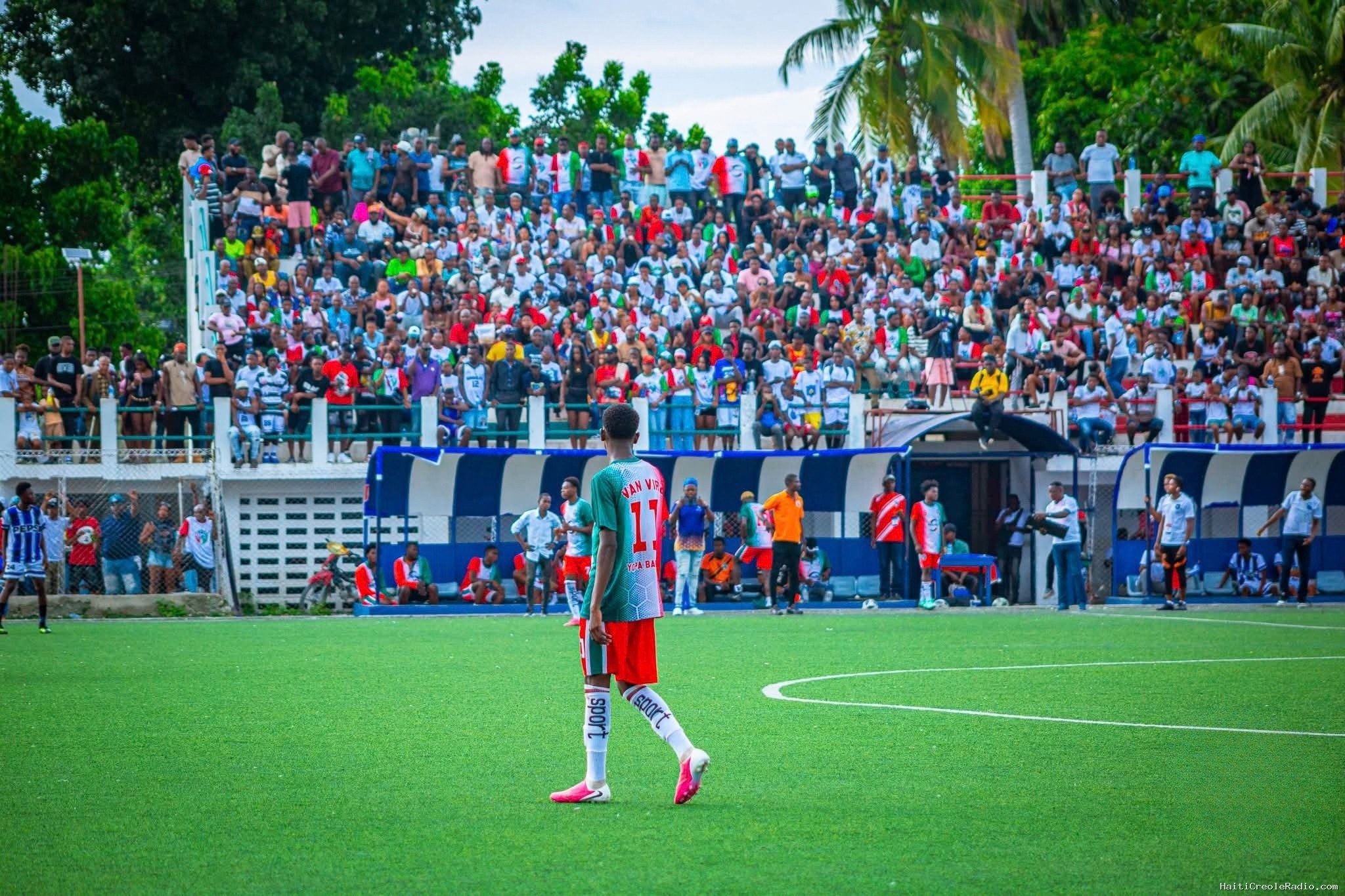
James Céné, a defensive midfielder, plays around the clock. During the formal Haitian Football League (LHF) season, he plays for Ouanaminthe FC. During the summer, he fields balls for summer league teams, including Pirates F.C. and F.C. Morina.
Going from a formal tournament to vacation series is a grueling pace that comes with a physical cost.
“We fall asleep on those motorcycle rides because we’re so tired. But we have to do it because that’s what we have,” Céné said. “Pills help us with the pain.”
With two systems co-existing, participants in all positions in the formal and vacation leagues have debated the question: Could Haiti use the energy, money and talent already flowing through the summer leagues to strengthen the formal league into one?
Some believe the answer is yes.
“If the vacation league teams can play, put them in the national league,” John Sévère, who coached in the LHF for 25 years, said. “If the league is doing a good reform, this is how they should do it.”
Others say no.
Jimmy Rémy, a member of the LHF’s executive committee, said it is not feasible for a vacation league club to compete among elite teams, where the champion plays in Concacaf’s regional tournaments.
“It’s impossible to just take a vacation team and put it in the top division,” Rémy told The Haitian Times. “It doesn’t make sense.”
The debate reflects a larger problem Haiti grapples with across all state institutions when individuals step in to fill a gap. When a solution arrives at a certain point, the question of sustaining or scaling it rises. In the case of soccer, as gang violence and political instability intensified around 2019, opportunities for the national league’s teams to compete declined. As these formal teams went into hiatus, privately-owned clubs in the informal leagues grew, but with an unclear path for any long-term survival.
“In 2017, 2018, before the country turned like this, when AS Sud-Est played in the first division, every game they played at home was like a huge event,” Douby Jean, a sports reporter with Haiti-Tempo, said.
“The country’s situation broke the national league.”
Vacation leagues fill gap
Haitian summer leagues began as recreational competitions for amateur players during school vacation, but their role has changed. They provide matches, attract spectators and create a way for players in the formal league to earn more post-season.
But over the years, the summer soccer leagues have come a long way from their humble recreational origins, where matches were played to pass the long vacation months. These days, spectacle has become part of the experience.
The number of vacation leagues across Haiti has yet to be evaluated, and the number of clubs and players in each league varies. For instance, organizers said the Mundialito in Gonaïves, the main city of the Artibonite Department, welcomes 24 teams, while the Interzone League of the Northwest has 15 clubs.
Players arriving in limousines, teams wearing elegant matching suits, match officials using Video Assistant Referee (VAR) technology and cheerleaders entertaining fans are visible aspects of an evolution some insiders say is also financially lucrative. The summer “season” has stretched into fall, evolving into a parallel market for players, coaches, club owners and fans. One where players can earn more money, play more often and attract larger crowds than the LHF, insiders say.
Their growing popularity comes as Haiti’s formal soccer structure for national competitions, the LHF, continues to struggle with financial, administrative and instability challenges.
Operating under the auspices of the Haitian Football Federation (FHF), the LHF has faced interruptions, unpaid officials and regional restrictions. Even as Haiti made its historic World Cup return and the women’s and youth divisions scored countless achievements, the feeder LHF faces numerous challenges.
In 2025, for example, the LHF season opening was postponed after referees refused to officiate over payment and equipment disputes. In 2024, nine Haiti-based under-20 players were unable to travel to Mexico for World Cup qualifying because of administrative and travel problems.
For players, the interruptions are more than administrative inconveniences. Fewer competitive matches mean fewer opportunities to develop and demonstrate their skills.
In come the summer leagues, acting as an alternative, with money, playtime and consistency.
Money flows in field, another struggles to manage
No official public data compares the budgets of summer clubs and LHF teams. But interviews with club owners and players indicate that summer teams can offer significantly more money per game.


Commentaires (0)
Laisser un commentaire
Aucun commentaire. Soyez le premier !