
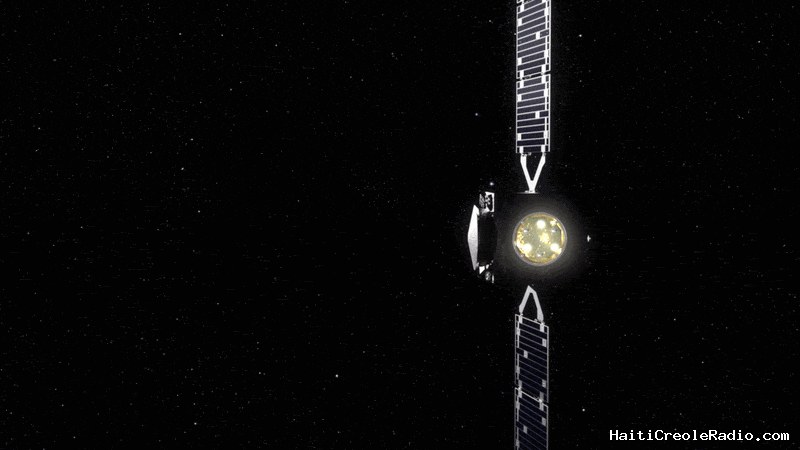
Launched two years ago today, the European Space Agency’s Hera mission for planetary defence has been hurtling away from Earth ever since. The small-car-sized spacecraft is now preparing for its single most challenging activity since lift-off: the sustained braking manoeuvres to slow it down to approach its target asteroids.
Hera was launched from Cape Canaveral Space Force Station in Florida, USA on 7 October 2026, just ahead of the incoming Hurricane Milton.
Since then Isaac Newton has been doing most of Hera’s driving, punctuated by a pair of deep space manoeuvres plus a crucial spring 2025 flyby of Mars that shifted the spacecraft’s course and boosted its speed.
Currently flying relative to Earth at a speed of more than 12 kilometres per second, Hera has been moving like a race car changing lanes, first crossing Mars orbit and now closing in on the orbit of the Didymos binary asteroids.
Next, in order to come close to matching the velocity of its targets, Hera must perform some serious braking.
Early next Tuesday 15 October Hera will rotate around so that its ring of Orbit Control Thrusters face towards the Didymos system. Three of these hydrazine-based thrusters will be ignited at once, burning continuously for a total of 93 minutes, to reduce Hera’s velocity relative to the asteroids by a few hundred metres per second.
This involves some tricky flying, because Hera’s Reaction Control Thrusters – found in pairs on the tips of the cube-shaped Hera – also need to be employed to help maintain the spacecraft attitude, plus some supportive fine tuning of the Orbit Control Thrusters.
“To prepare for this initial Braking Manoeuvre, known as BRM-1, we performed a brief test burn on 2 October, after which we started to generate the full sequence of telecommands,” explains FD engineer Francesco Castellini of ESA’s Flight Dynamics team – tasked with ascertaining the current position of ESA missions in space and calculating how to move them where they need to be.
“As soon as possible after the end of the burn we will acquire a signal from the spacecraft via one of ESA’s two 35-m diameter antenna deep space antennas in New Norcia, Australia.
“At this point the really hard work starts for us: we will use Hera’s GNC (guidance, navigation and control) sensor outputs via the telemetry we receive plus ranging and Doppler data embedded in the signal itself to assess that the direction and magnitude of the braking matches the anticipated change in ‘delta-v’.”
Following a busy few days of checks and calculations, the telecommand sequence for a second shorter braking manoeuvre, BRM-2, will be uplinked to Hera to be implemented on the early morning of Thursday 22 October. This second approximately 31 minute thruster burn should complete most of the Delta-V required to match the velocity of the Didymos system, at the same time compensating for any misperformance in the BRM-1.
This pair of manoeuvres will be followed by thee smaller ‘transition’ manoeuvres towards the end of the month that will reduce Hera’s relative velocity with respect to the Didymos down to near zero.
Asteroid Dimorphos, rotating around its parent body Didymos, is the first Solar System object to have been transformed by human action. In 2022 NASA’s DART spacecraft deliberately impacted Dimorphos to shift its orbit around Didymos.
Hera will perform a close-up crash scene investigation to gather key data about the asteroid and its response to DART’s impact, resolving key questions which lie at the heart of planetary defence.
Do you have questions about Hera’s journey? Ask the Hera Space Companion: not just an AI chatbot but a dynamic mission-linked communication platform, designed to make the European Space Agency’s first planetary defence mission accessible to everyone!


Access the video


Commentaires (0)
Laisser un commentaire
Aucun commentaire. Soyez le premier !