
The second generation of Galileo, Europe’s satellite navigation constellation, is being built. These satellites will feature reconfigurable payloads, provide more robust and reliable positioning, navigation and timing, enable new services and add new capabilities to the constellation.
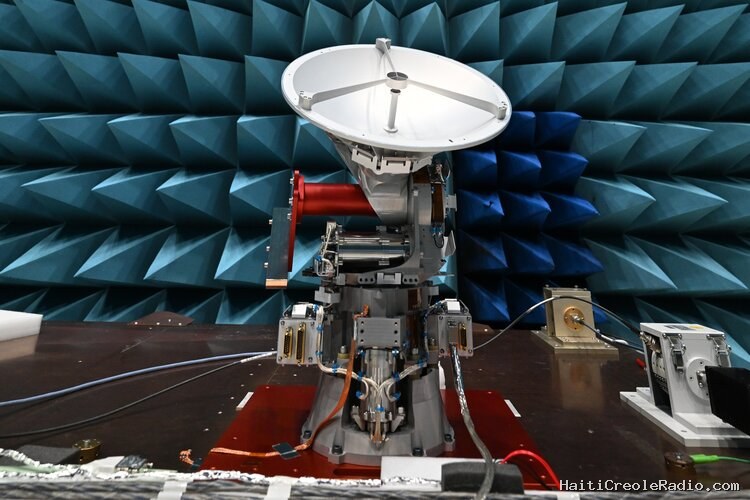
One of these capabilities, intersatellite links, will allow the satellites to communicate with one another in orbit. After going through extensive testing, the intersatellite link antennas are ready to be integrated into the satellites.
Galileo currently relies on communication links between satellites and ground stations to exchange information. However, this means that a satellite must be visible in the sky for a ground station to make contact.
With intersatellite links, the new generation of Galileo satellites will be able to talk directly to one another in orbit, exchanging information on timing and location. This also means that if a specific satellite is not visible from the ground, a message can be sent to a different satellite and then passed on.
Before the intersatellite link antennas can fly on Galileo, they are undergoing rigorous testing to ensure they will work flawlessly in orbit. These tests are being carried out under Thales Alenia Space and Airbus Defence and Space, the companies leading the development of the two families of Galileo Second Generation satellites under contract with ESA, the Galileo design authority for the European Union.
Millions of movements
Each Galileo Second Generation satellite will be equipped with two intersatellite link terminals that will allow it to communicate with other second generation satellites. The pointing mechanism of the terminal will reorient the antenna every 40 seconds to point towards a different satellite. Over the expected 15-year lifetime of the satellites, this will amount to 12 million reorientations.
To ensure the antenna pointing mechanism will work in space, without any maintenance, models of the mechanism were tested here on Earth.
In a seven-months-long test at Beyond Gravity’s facilities in Switzerland that finished in March 2026, the antenna pointing mechanism for Thales Alenia Space reoriented itself 15 million times in a row, verifying that it can last the planned lifetime of the second generation satellites.
As Beyond Gravity's tests were finishing, another model of the antenna pointing mechanism underwent electromagnetic compatibility testing and micro vibration testing as a part of the test campaign for the flight hardware system at ESA's technical centre in Noordwijk, the Netherlands. These tests ensured that it can function in the space environment. Following delivery to Thales Alenia Space in Spain, the mechanisms are integrated on the intersatellite link panel and then shipped to Rome for satellite integration.
Tests on key mechanical components of the antenna pointing mechanism of the Airbus Defence and Space satellite family were completed by MDA Montreal in February 2025. These tests verified that the components will be able to last 15 years in space.
Even as individual mechanical components were being tested, teams from ESA, Airbus Defence and Space and TESAT also completed the Test Readiness Review for the first flight model of the antenna pointing mechanism at MDA Montreal in February 2024.
The flight model of the antenna pointing mechanism, which will actually fly in space, completed environmental and radio frequency testing at MDA Canada in December 2025. These tests verified that it can survive the trip to and life in space and that it can communicate as expected and does not interfere with itself or other satellites.
In recent months, the first two Airbus Defence and Space antenna pointing mechanisms were delivered to TESAT in Germany, where they will be integrated into the full intersatellite link module and then the full satellite.
Ready for the next step
The Galileo Second Generation satellites and ground segment are developing at a rapid pace. As the intersatellite links are being tested and integrated into the satellites, the ground segment is being deployed and tested to ensure the new satellites will integrate seamlessly with the current Galileo satellites.
Even with the addition of intersatellite links, the ground segment will continue to play a crucial role in the Galileo system. It will monitor and send correction messages to the satellites, acting as the 'brains’ of the constellation. The intersatellite links will add a layer of robustness to the system and enable additional time synchronisation and ranging measurements of the satellites, which will ultimately improve Galileo's performance.
About Galileo
Galileo is currently the world’s most precise satellite navigation system, serving billions of smartphone users around the globe since entering Open Service in 2016. All smartphones sold in the European Single Market are now guaranteed Galileo-enabled. In addition, Galileo is making a difference across the fields of rail, maritime, agriculture, financial timing services and rescue operations.
The Galileo programme is managed and funded by the European Commission under the EU Space programme. Since its inception, ESA leads the design, development and qualification of the space and ground systems. ESA is also entrusted with research and development activities for the future of Galileo within the EU programme Horizon Europe. The EU Agency for the Space Programme (EUSPA) acts as the service provider, bringing the satellites into service and overseeing their operation and the market and application needs.
For more info about Galileo: https://www.usegalileo.eu/EN/



Commentaires (0)
Laisser un commentaire
Aucun commentaire. Soyez le premier !