
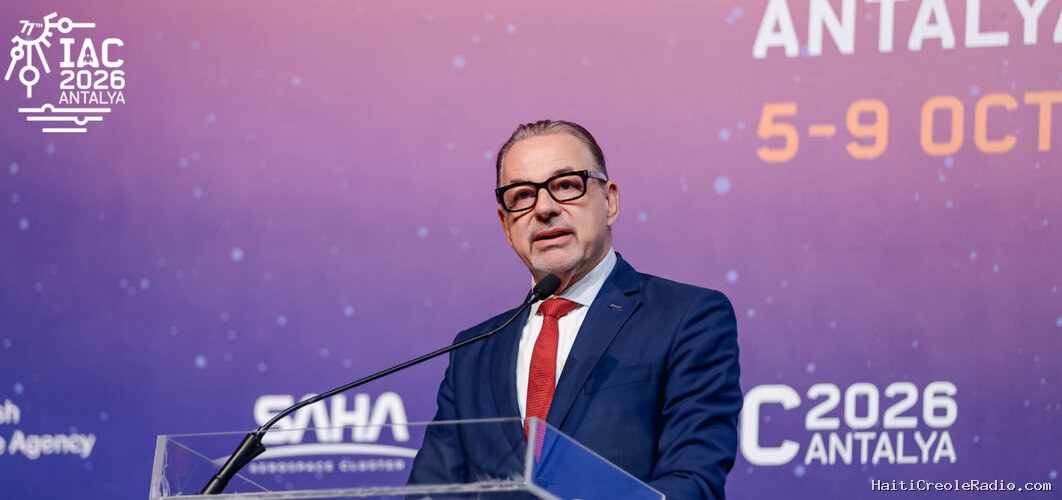
Stronger European capabilities and deeper international cooperation were at the heart of ESA’s first day at the 77th International Astronautical Congress (IAC) in Antalya, Türkiye. From exploration to the contribution of space to society, ESA Director General Josef Aschbacher underlined the importance of Europe becoming a stronger and more capable partner in a rapidly changing space environment.
Held for the first time in Türkiye, this edition of the IAC brings together space agencies, governments, industry, academia and other participants under the theme ‘The World Needs More Space’. Organised by the International Astronautical Federation (IAF), hosted by the Turkish Space Agency and co-hosted by the SAHA İstanbul Aerospace Cluster, the congress runs from 5 to 9 October.
The opening ceremony brought the international space community together to mark the formal start of the congress. Speakers included the President of the Republic of Türkiye Recep Tayyip Erdoğan; the Minister of Industry and Technology Mehmet Fatih Kacır; and the President of the IAF Gabriella Arrigo.
The first event of the day was a ministerial round table on 'Space: a national strategic priority?', moderated by ESA Director General Josef Aschbacher. The discussion brought together the Minister of Industry and Technology of Türkiye; the Minister of Sports of the United Arab Emirates Ahmad Belhoul Al Falasi; the Secretary of State at Spain’s Ministry of Science, Innovation and Universities Juan Cruz Cigudosa; the Secretary of State at Poland’s Ministry of Economic Development and Technology Michał Jaros; and the Minister of Digital Technologies of Uzbekistan Sherzod Shermatov.
Cooperation is essential for space activities
Later in the morning, Josef Aschbacher joined IAF Vice President for Space Agency Relations Enrico Palermo for the opening plenary session, ‘One-to-One with Heads of Space Agencies’. He spoke immediately after a discussion between IAF President Gabriella Arrigo and NASA Deputy Administrator Matt Anderson.
ESA Director General stressed the importance of ESA’s contribution to international partnerships, citing cooperation with NASA on the Artemis missions while highlighting ESA’s work with an increasingly diverse range of partners, like Japan, Australia, the United Arab Emirates and India, as well as ESA’s longstanding partner Canada.
Referring to NASA’s Ignition event, which outlined a new approach to future lunar exploration and had been highlighted by Matt Anderson, Josef Aschbacher said it had inspired Europe to be bold and “to make sure we are a strong partner”, by strengthening Europe’s capabilities and autonomy while remaining committed to international cooperation.
He explained that ESA now has a clear mandate to prepare decisions for the Intermediate Ministerial Meeting in Rome in December on strengthening the autonomy and capabilities in human and robotic exploration. Among the questions being examined is whether Europe should develop its own capability to transport astronauts.
“Not to isolate ourselves, quite the opposite: to be a very strong partner with the many countries we are already working with and with whom we would like to intensify our cooperation,” he said.
The importance of combining strong capabilities with international cooperation was also highlighted by Yusuf Kıraç, President of the Turkish Space Agency, in his opening remarks.
“The future of space will not be built by one country or one agency alone. It will require strong, resilient capabilities, responsible leadership and effective international cooperation. This is also closely connected to the theme of IAC 2026: ‘The World Needs More Space’.”
Putting space at the service of society
Reflecting on the theme of IAC 2026, ESA’s Director General said the discussion should not focus only on having more activity in space, but about how space can benefit people, societies and countries.
“This is exactly what we are doing at ESA,” he added.
Space systems support services on which modern societies increasingly depend, from navigation and communications to weather forecasting, environmental monitoring and emergency response. He also noted that, according to the Organisation for Economic Co-operation and Development (OECD), space-based systems support more than half of the world’s most critical infrastructures and services, including transport, energy, communications, and food supply.
Preparing for the post-ISS era
During this first day at IAC 2026, ESA signed a Memorandum of Understanding with Vast, continuing their collaboration and paving the way for potential future cooperation in low Earth orbit. The agreement forms part of ESA’s preparations for the end of International Space Station operations and its deorbiting, as the agency explores options to maintain European access to microgravity research and future flight opportunities for European astronauts.
The press release can be read here.
Europe’s ambitions on display
ESA welcomed delegates to its 150 m² exhibition, presented under the theme ‘European Space Agency: Elevating the Future of Europe’. Through mission models, images and videos, the exhibition highlights the five goals of ESA Strategy 2040, alongside recent achievements, upcoming missions and the importance of international partnerships. The first day’s programme at the ESA booth included a discussion on the space economy with Charlotte Mathieu, ESA Head of Space Economy and Industrial Policy Division and Bhavya Lal of the RAND School of Public Policy.


Commentaires (0)
Laisser un commentaire
Aucun commentaire. Soyez le premier !