
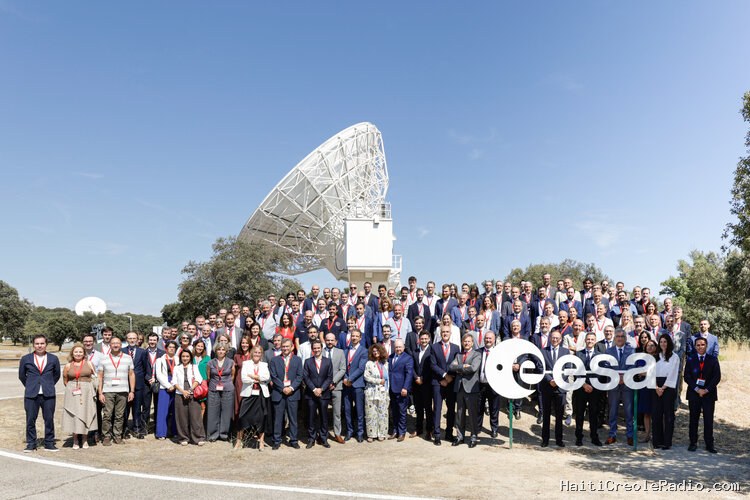
The European Space Agency (ESA) has signed 18 consolidation contracts bringing together nearly 80 companies to study new secure and resilient connectivity services. The contracts also cover associated mission concepts and aim to shape the future of the EU's secure connectivity constellation – IRIS² – which will provide Europeans with resilient communications, when and where it matters most.
The companies will develop relevant use cases and services, and trade-off different mission concepts as part of ESA’s Low-LEO (low Earth orbit) activities, helping to explore how IRIS² capabilities could evolve as new European needs emerge.
Signed on 17 September at the ESA European Space Astronomy Centre (ESAC) in Madrid, Spain, the agreements mark the start of a new phase of studies under the ESA Programme Related to EU Secure Connectivity. The services being explored are aimed at governmental users and range from secure governmental broadband, maritime operations and aviation to data relay and tasking, among others.
These contracts will strengthen Europe’s industrial base while giving smaller and mid-sized companies opportunities to contribute to the development and validation of new secure connectivity services through the Low-LEO layer. The resulting capabilities could, subject to their successful maturation and future programme decisions, support a potential evolution of the main EU IRIS² system as user needs evolve.
Amounting to a total of €20 million, the contracts were signed by Laurent Jaffart, ESA’s Director of Resilience, Navigation and Connectivity, together with representatives from the participating industry teams, at an event attended by representatives of the European Commission.
“Space is evolving rapidly, and Europe needs to evolve with it. Low-LEO provides the opportunity to explore new ideas and capabilities, test them in practice and learn from the results. This ability to innovate, adapt and build on experience will be essential as we develop the next generation of secure and resilient connectivity for Europe. We look forward to continuing to work hand-in-hand with the European Commission and industry on the future of IRIS²,” said Laurent Jaffart, Director of ESA’s Resilience, Navigation and Connectivity.
What is IRIS²?
Under the overall responsibility of the European Commission, IRIS² is Europe’s initiative to build a secure and resilient space-based connectivity network. In these challenging times, its aim is to strengthen Europe’s strategic autonomy by providing reliable connectivity and reducing dependence on external systems.
ESA acts on behalf of the European Commission as the qualification and validation authority for the governmental infrastructure of the EU's Secure Connectivity Programme. It manages development and validation contracts supporting the initial space and ground segments, verifies end-to-end system, service, and security performance against EC requirements, and coordinates these activities with ESA’s own programme.
ESA Programme Related to EU Secure Connectivity
Additionally, ESA through the ESA Programme Related to EU Secure Connectivity. also supervises future infrastructure generations and service evolution.
Today’s consolidation contracts signatures relate specifically to ESA’s Low-LEO component, which aims to provides a rapid and recurrent mechanism for validating new potential governmental services and associated mission concepts in orbit at pre-operational level, supporting their maturation and possible later integration into the operational EU IRIS² baseline subject to future programme decisions
In-orbit validation before integration
Based on the outcomes of these activities, ESA will initiate a number of procurements for the subsequent Implementation phase for a concrete set of missions, planned for implementation along 2027–2029, to validate the targeted services in orbit at pre-operational level, along with relevant user groups and in close coordination with the European Commission.
These results will help prioritise those services that could potentially be incorporated into future versions of EU IRIS², supporting Europe’s ability to adapt to an ever-changing and challenging global landscape.



Commentaires (0)
Laisser un commentaire
Aucun commentaire. Soyez le premier !