
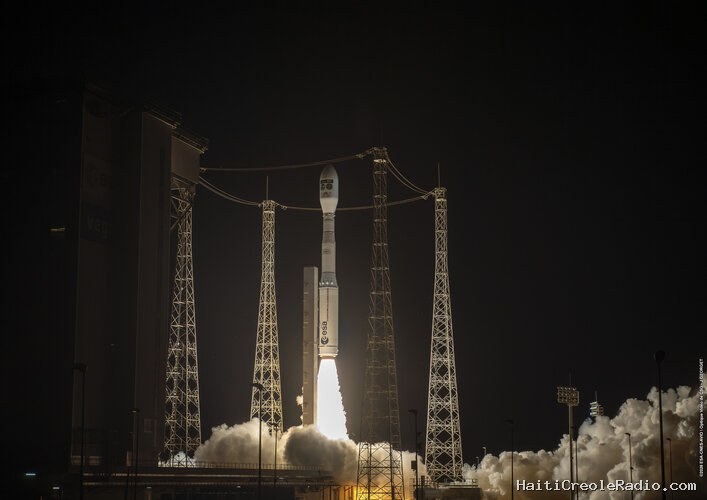
The European Space Agency’s FLEX Earth Explorer satellite and the Copernicus Sentinel-3C satellite have been launched together aboard a Vega-C rocket from Europe’s Spaceport in French Guiana, marking a new milestone in Europe’s Earth Observation Programmes.
Flight VV30 lifted off on 15 September at 03:21 (14 September at 22:21 local time).
A launch adapter called Vespa allowed both satellites to be stacked inside the Vega-C fairing for launch. Positioned on top of Vespa, Sentinel-3C was injected into orbit first, followed by FLEX approximately one hour later.


Access the video
Following the satellites’ separate deployments, ESA’s European Space Operations Centre in Germany received the all-important first signal from each satellite, confirming that both had been safely released from the rocket and had established contact with ground control.
Mission controllers will now spend the coming days conducting the ‘launch and early orbit phase’, meticulously checking and verifying the health and performance of both satellites and confirming that all systems are functioning as expected.
ESA’s Director of Earth Observation Programmes, Simonetta Cheli, said, “Today’s launch is the culmination of years of scientific innovation, engineering excellence and international cooperation.
“Developed within ESA’s FutureEO programme, FLEX is a research mission that will advance our understanding of plant health and the role of photosynthesis in the carbon and water cycles. Sentinel-3C is the third satellite in the Sentinel-3 series, systematically measuring Earth’s oceans, land, ice and atmosphere to support Europe’s Copernicus Services.
“Preparing and launching two satellites together is no easy task. My thanks go to the many experts who have contributed throughout both satellites’ development, testing and preparation for launch, and who have worked tirelessly to ensure that both satellites have reached orbit safely.”
FLEX to reveal the hidden activity of Earth’s vegetation
FLEX, the latest Earth Explorer mission, is ESA’s first satellite designed specifically to measure photosynthetic activity from space. Its Fluorescence Imaging Spectrometer will detect the extremely faint fluorescence emitted by plants as they absorb sunlight during photosynthesis.
This signal, invisible to the human eye, provides a direct indication of how efficiently vegetation is converting sunlight and carbon dioxide into energy. FLEX measurements will help scientists assess plant health, ecosystem productivity and the effects of environmental stress and climate change.
Sentinel-3C strengthens Europe’s environmental monitoring
Copernicus Sentinel-3C is the third satellite in the Sentinel-3 series and will continue the long-term collection of essential environmental data.
Its suite of instruments will systematically observe the oceans, land, ice and atmosphere, measuring parameters including ocean and land-surface temperatures, ocean colour, sea and ice conditions, vegetation and inland-water levels. The mission will provide near-realtime information supporting ocean forecasting, climate monitoring, environmental management and scientific research.
Sentinel-3C is part of Copernicus – the Earth observation component of the EU’s Space programme. For the Sentinel-3 satellites, ESA is responsible for the development. After the commissioning phase, the Sentinel-3 mission is jointly managed by ESA and Eumetsat, where Eumetsat is responsible for routine spacecraft operations and the delivery of marine and near-realtime atmospheric data, while ESA delivers land, cryosphere, inland water and offline atmospheric products. Together, the two agencies provide mission data and services to users worldwide.
A shared journey into orbit
FLEX and Sentinel-3C were launched on Vega-C flight VV30, demonstrating the launcher’s ability to place two Earth observation missions into their different required orbits. FLEX was encased within the Vespa secondary launch adapter, with Sentinel-3C on top.
An evolution of Europe’s Vega family of rockets, Vega-C can launch 2300 kg into low-Earth orbit. It weighs 210 tonnes on the launch pad and reaches orbit with three solid-propellant-powered stages before the fourth liquid-propellant stage takes over for precise placement of satellites into their desired orbit around Earth.
ESA leads the Vega-C programme, working with Avio as prime contractor and design authority. For this launch, Avio was also the launch service operator.
Looking ahead
The two satellites have travelled a long road from development and integration through final testing and preparation for liftoff at Europe’s Spaceport.
Their successful deployment into orbit around Earth now begins the next phase – where teams at ESA’s European Space Operations Centre will commission the satellites and their instruments to ready them for their duties in orbit.
Once fully operational, Eumetsat will assume responsibility for operating the Sentinel-3C satellite, while FLEX remains under ESA’s control. However, some orbital gymnastics will be performed as, initially, FLEX will orbit in tandem with Sentinel-3A, and then later Sentinel-3C will be moved to replace Sentinel-3A in this tandem formation.
In tandem
This tandem arrangement benefits FLEX, allowing its measurements of the faint fluorescence emitted by vegetation to be combined with near-simultaneous observations from Sentinel-3.
Sentinel-3 provides complementary information on the atmosphere – including clouds, aerosols and water vapour – as well as the land surface, including surface temperature, land-cover type and additional vegetation parameters. Bringing these measurements together with FLEX’s observations will give scientists an unprecedented view of the health and functioning of vegetation around the world.


Commentaires (0)
Laisser un commentaire
Aucun commentaire. Soyez le premier !