
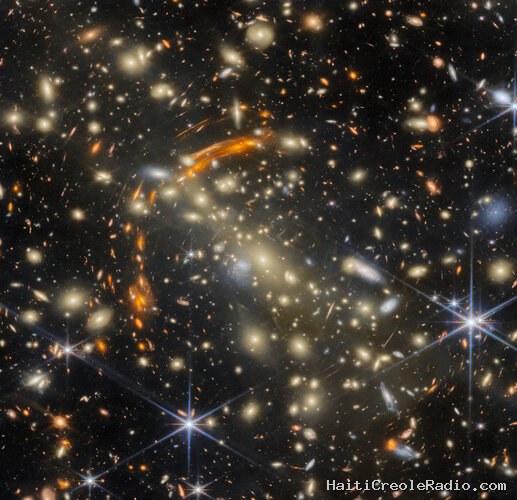
This NASA/ESA/CSA James Webb Space Telescope Picture of the Month features galaxies in great detail that have been warped and multiplied like they’ve stepped into a house of mirrors. The brilliant golden galaxies splashed across this image belong to a galaxy cluster called MACS J0454.1-0300. The orange galaxies concentrated on one side of the cluster are not actually part of the cluster and are much farther away from us.
MACS J0454.1-0300 is itself immensely distant: the light from these galaxies has been travelling to us for so long that we’re seeing the cluster as it was when the Universe was about 8 billion years old. While this galaxy cluster is a valuable scientific target in its own right, the real stars of this image are the galaxies that appear warped and stretched, like a painting that has been smeared by a giant hand.
The way these galaxies look is the result of gravitational lensing, in which the enormous mass of a foreground object such as a galaxy cluster bends and magnifies the light from a more distant object in the background. Gravitational lensing allows astronomers to observe galaxies, star clusters and even individual stars that are too far away for our telescopes to see under normal conditions. While the large, orange galaxies appear obviously distorted, look carefully at some of the small reddish background galaxies throughout this picture: even at the very edges of the frame, there are galaxies whose images have been bent into tiny arcs by MACS J0454.1-0300’s gravity.
The gravitationally lensed areas show multiple images of galaxies from when the Universe was young: a group of galaxies 2 billion years after the Big Bang, and a single galaxy just 800 million years old after the Big Bang. The galaxy group appears to be going through a merger, resulting in an enormous burst of star formation.
Astronomers have also identified individual bright ‘knots’ within the gravitationally lensed areas, corresponding to regions as small as 5 light-years across. These tiny clumps appear magnified by a factor of more than 300, in some cases.
A NASA/ESA Hubble Space Telescope image of this same cluster was released in 2014. Take a moment to compare the two images; the difference between them is dramatic. The new Webb image reveals hundreds of galaxies missing from the earlier image. These galaxies were there all along, but Webb is much more sensitive to their much redder light.
The data behind this image come from two observing programmes (#5058, PI: Furtak; #6882, PI: Fujimoto) that leverage the ability of massive galaxy clusters to bring distant objects into view.
[Image Description: A massive galaxy cluster, made of many golden elliptical galaxies with the largest, brightest one in the centre. Heavily distorted orange galaxies appear all around the cluster, the largest concentrated in a large arc around the cluster's centre; these are images of very distant galaxies, created by gravitational lensing. A few galaxies are large and bluish-white in colour; bright, nearby stars are the same colour.]


Commentaires (0)
Laisser un commentaire
Aucun commentaire. Soyez le premier !