
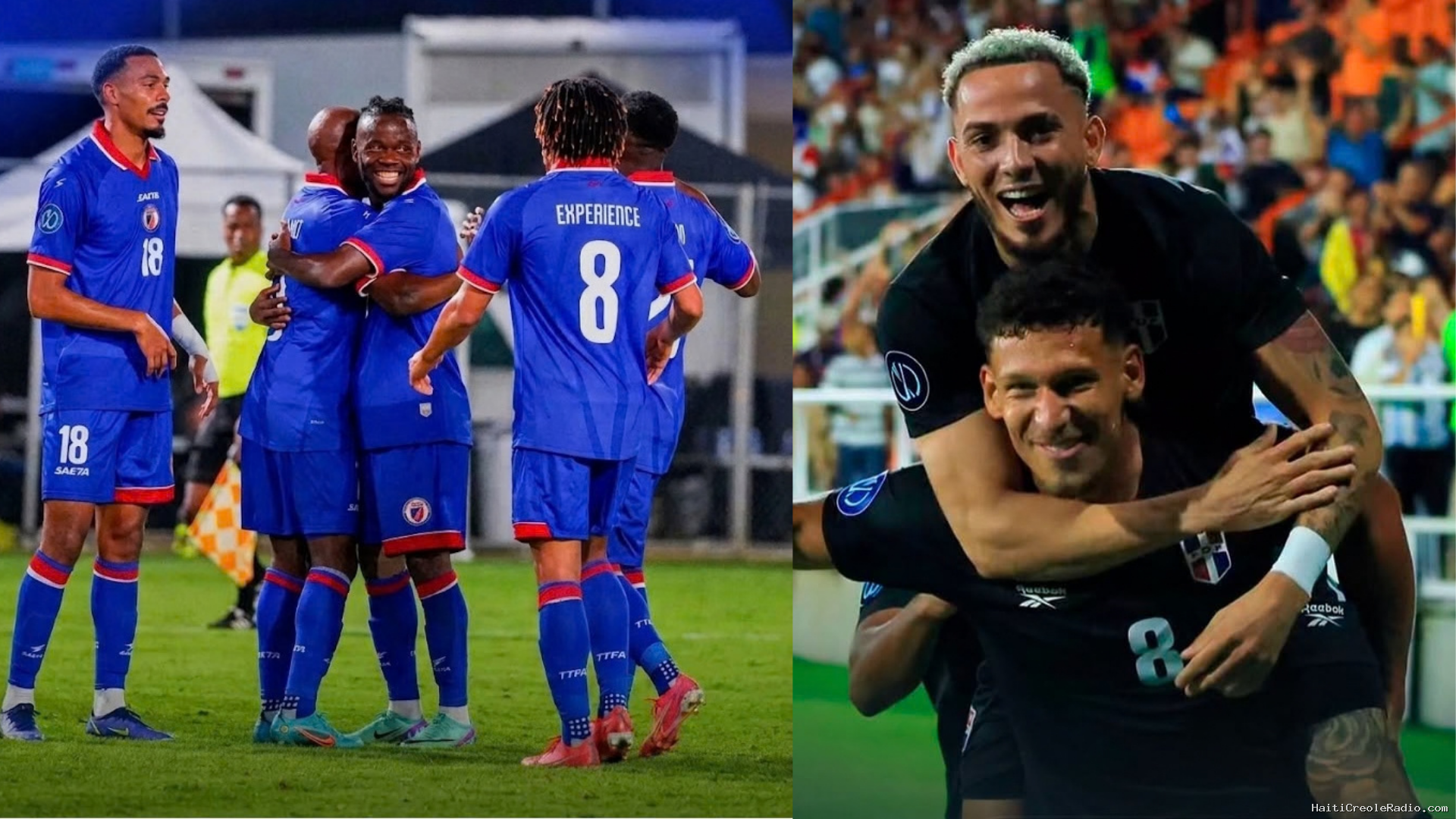
FORT-LIBERTÉ — Haiti and the Dominican Republic meet Thursday night in a sold-out Félix Sánchez Olympic Stadium match that carries more than three points at stake.
The game starts at 8 p.m. ET, with both teams looking to strengthen their position in Group A of the Concacaf Nations League A and move closer to the quarterfinals.
For Haitians and Dominicans watching from both sides of the border and the 23,000 or so in attendance, however, the game carries another weight. It also arrives against the backdrop of a relationship marked by deep historical wounds, economic and social interdependence, migration disputes and recurring political tensions.
“This match will not only be about sports,” said Érick Jasmin, a Haitian sports journalist with Radio Télé Wanavision in Haiti’s Northeastern border town, Ounaminthe.
The two countries share the island of Hispaniola and maintain extensive commercial, family and social ties. Haitians work in the Dominican Republic, Dominican goods cross into Haiti and communities on both sides of the border interact daily. At the same time, the countries have repeatedly clashed over migration, border security and the treatment of Haitians and people of Haitian descent in the Dominican Republic. The memory of the 1937 massacre, when thousands of Haitians and Dominicans of Haitian descent were killed under the regime of Dominican dictator Rafael Leónidas Trujillo, remains part of that history.
Thursday’s match brings those contradictions into a highly visible setting: two neighboring nations that depend on one another in many ways, yet regularly find themselves in political and social tension.
“It will also have a political and diplomatic dimension, given the tensions surrounding the canal on the Massacre River and the migration measures targeting Haitians in the Dominican Republic,” Jasmin told The Haitian Times.
A rivalry with something to prove
On the field, the stakes are straightforward.
Haiti, the Dominican Republic and Costa Rica entered the third matchday with six points apiece after winning their first two Group A matches. Haiti had defeated Trinidad and Tobago 3-2 before beating Costa Rica 2-0. The Dominican Republic opened with a 3-2 victory over Nicaragua and then defeated Trinidad and Tobago 2-1.
Only the top two teams in each six-team League A group advance to the quarterfinals.
That makes Thursday’s match particularly important for both teams, while the sold-out stadium adds another layer of national pride.
For Jasmin, the contest carries particular significance because soccer is one of the few areas in which he believes Haiti has maintained an edge over its neighbor.
“The only relationship that really works between the two countries is trade,” Jasmin said. “Over the past 20 years, football is the only area in which we have been more advanced than the Dominican Republic.”
The two teams have not met regularly at the senior level in recent years. According to 11v11 records, Haiti has won nine of 13 official senior meetings since 1976, with two draws and one Dominican victory. The teams last met in March 2013, when the Dominican Republic snatched its only victory over Haiti, 3-1, in a friendly.
A game carrying a complicated history
The soccer match offers a snapshot of a relationship that rarely fits neatly into either cooperation or conflict.
Hundreds of thousands of Haitians live and work in the Dominican Republic, while trade across the border is an important part of both economies. Families also span the border, creating connections that persist despite political disputes.
Yet migration has repeatedly strained relations.
Dominican authorities have increased deportations of undocumented Haitians and introduced or expanded measures affecting Haitian migrants. Haitian officials and human-rights advocates have repeatedly raised concerns about discrimination and the treatment of Haitians and Dominicans of Haitian descent.
Tensions have also emerged over border infrastructure and water resources, including the dispute over the canal on the Massacre River.
The result is a relationship in which cooperation and confrontation often exist simultaneously.
For younger Haitians and Dominicans, those tensions can make a soccer rivalry feel personal.
Luckni Dalusma, a Haitian journalist reporting from the Dominican Republic, agrees.
“This match is very important for both countries, especially regarding how the leaders view Haitians,” Dalusma said. “Football is used to promote peace, but fanaticism cannot be avoided.”
The match also comes days before the anniversary of one of the darkest episodes in Haitian-Dominican history.
In early October 1937, forces under Trujillo’s dictatorship carried out a campaign of killings against Haitians and Dominicans of Haitian descent, particularly in border communities. Thousands were killed over several days.
The massacre became known as the Parsley Massacre because soldiers reportedly used the pronunciation of the Spanish word for parsley, perejil, to identify people they suspected of being Haitians.
In Haiti, the killings are also commonly remembered as Kout Kouto or “the knife killings.” The episode remains an enduring reference point in discussions of Haitian-Dominican relations and demands for reparations.
Ninety minutes, decades of history
For the players, when the match kicks off, the objective remains clear: win or collect a result that strengthens their position in the Nations League A’s Group A.
In a pre-match presser Wednesday, Haiti captain Carlens Arcus emphasized the goal and the importance of the Haitian community in the Dominican Republic.
“We are very excited and focused,” Arcus said. “We want to deliver a victory, especially to the Haitian community here.”
Yet for the thousands inside the stadium and the millions following from Haiti, the Dominican Republic, and the rest of the diaspora, the match’s meaning is more complicated.
In an interview with local outlet Dario Libre, Dominican national team coach Marcelo Neveleff urged supporters to keep the encounter focused on soccer and avoid letting political and social tensions between the two countries overshadow the match.
“A soccer field cannot resolve the disputes between two countries sharing one island,” said Liogens Louis, a Haitian migrant living in the Dominican Republic. “Nor can a victory erase historical trauma or settle disagreements over migration, borders or economic relations.”
But the match will provide a highly visible moment for Haitians and Dominicans to express national identity and pride — sometimes competitively, sometimes joyfully and, potentially, contentiously.
“That is what makes Haiti-Dominican Republic different from an ordinary regional soccer fixture,” Louis added.
“The two teams are competing for points and quarterfinal qualification, but their supporters are also carrying the attachment to their roots; the history of two nations whose lives have remained closely connected even when their governments and communities have been divided. On Thursday night, that complicated relationship will play out in 90 minutes of soccer,” Louis said.
Commentaires (0)
Laisser un commentaire
Aucun commentaire. Soyez le premier !