
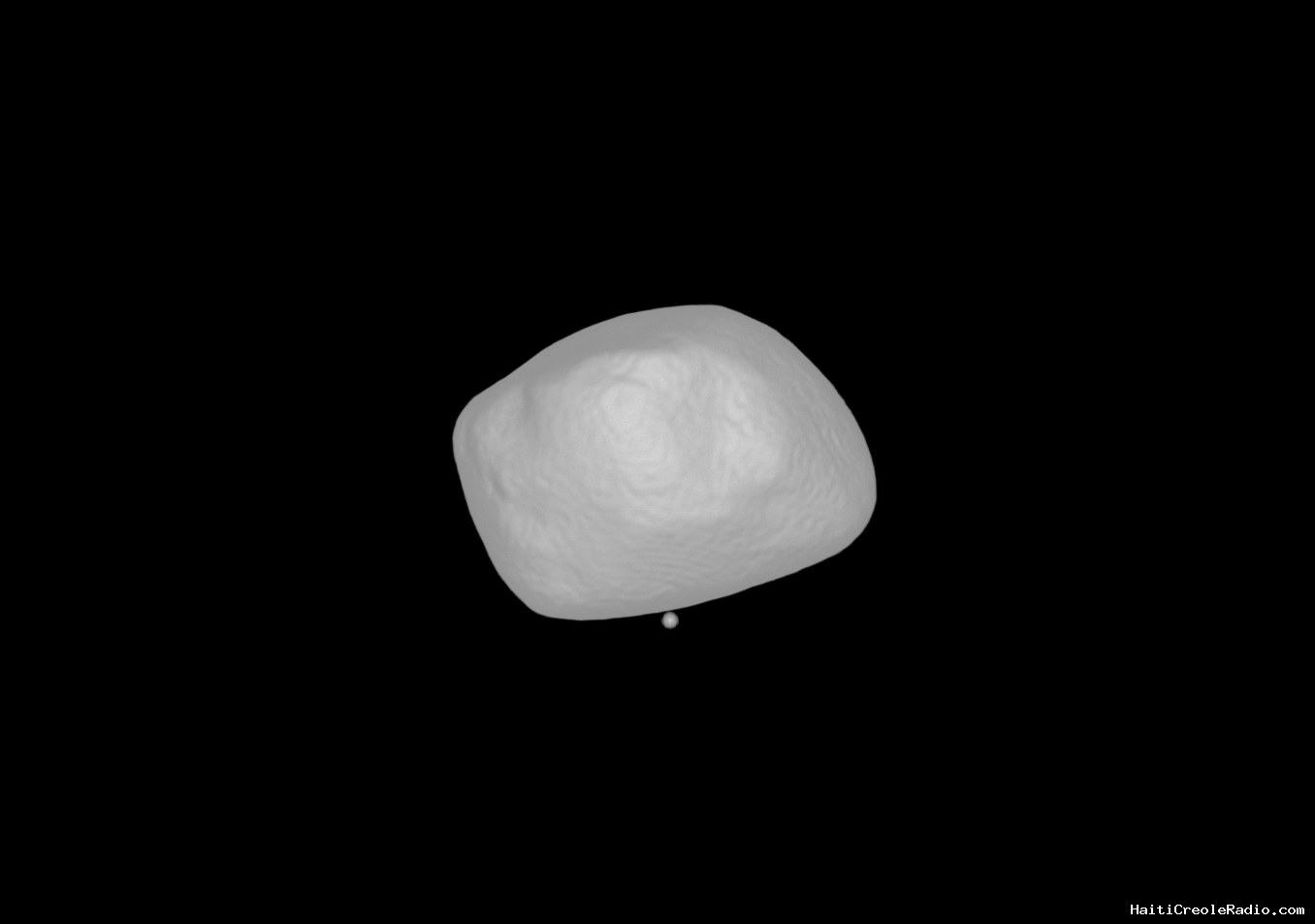
A new study – guided by flyby images from ESA’s Hera asteroid mission – suggests that Mars’s small outer moon Deimos has been dramatically reshaped by a single violent asteroid impact. This would account for its mysteriously smooth and youthful face: a thick layer of dust from the impact may have served as the planetary equivalent of cosmetic fillers.
The potato-shaped Deimos – 12 km in diameter, about the size of Luxembourg city – orbits about 24 000 km from the surface of Mars. When first visited by NASA’s 1970s Viking orbiters it was found to have a much smoother and dustier appearance than heavily cratered and creviced Phobos, the other Martian moon. Its other main feature is a dramatic 10-km-wide basin around its southern pole, like a saddle between mountains.
Simulating Deimos impacts
Deimos’s distance from Mars makes it comparatively hard for spacecraft to visit – the most recent images came from the European Space Agency's Hera mission as it performed a flyby of Mars in March 2025. However a leading theory is that its south polar depression and dusty nature are both due to a single asteroid impact.
A new study published in Nature Astronomy this week employed high-resolution impact simulation software to try and recreate this catastrophic but non-destructive event in a way that matches the state of Deimos as seen today.
The study was led by Sabina Raducan of the University of Bern, International Space Science Institute (ISSI) and VUB Brussels University: “Run on a High Performance Computing Cluster at the University of Bern, our Bern Smoothed Particle Hydrodynamics, SPH, impact code works by recreating bodies of interest into millions of adhering particles whose interplay is governed by various programmable variables, including gravity levels, material strength and cohesion.
“In this case we created a detailed shape model of Deimos out of SPH particles, having filled in the southern depression to leave it ready for the impactor to strike. Then we ran about a hundred simulations – each one taking about a week at a time to complete – to experiment with various impactor masses and angles of approach.”
Their best fit proved to be a slanting, approximately 45-degree, impact from a relatively small 320-m-wide asteroid, striking the moon at high speed. Rather than shattering Deimos, the collision excavated a broad depression at its south pole while throwing large amounts of material across the surface.
Aftermath of collision
Much of this debris later fell back, forming a global blanket of loose regolith that covered many of its existing surface features – to a depth of more than two hundred metres in some places.
Sabina Raducan, who is also one of the chairs of the Impact Physics Working Group for the Hera science team, explains: “Our simulation is consistent with patterns of brightness observed across the moon’s surface, linked to the gradual migration of regolith that behaves more like loosely packed dust than anything more cohesive. The same is true of the way the southern depression subsequently smoothed out, rather than retaining a sharp crater.”
Beneath this dust layer, the outlines of ancient craters remain identifiable, a finding which offers valuable insight into the underlying structure of the Martian moon.
She adds: “We began this simulation campaign before Hera’s Mars flyby, but with the hope that Hera’s observations would help constrain the results even more. This indeed turned out to be the case, as the side of the moon imaged by Hera turned out to show additional buried craters.
“These were really the last pieces of the puzzle I needed – although they weren’t immediately obvious to the naked eye. Instead I first made them out via spectroscopic depictions of the Hera images made immediately afterwards by Sir Brian May, who is part of the Hera science team.”
Insight into the moon’s interior
The continued presence of these pre-impact craters suggests that Deimos is relatively fragile in nature. Impact shockwaves would have echoed through a more solid body like the ringing of a bell, disrupting or erasing older features. Their survival is indicative of a highly porous, fractured interior that dampened down impact forces efficiently to sub-catastrophic scale.
Michael Kueppers, ESA’s Hera project scientist comments: “This simulation therefore implies that Deimos is a rubble-pile body, akin to many asteroids. This does not necessarily mean the moon is in fact a captured asteroid – it might well have formed out of material kicked up from Mars by surface impacts – but more that it may have formed in a similar way and therefore shares comparable properties. This is the first of a series of results demonstrating how tuning Hera’s Mars flyby to get close to Deimos has paid off well in terms of science.”
Space missions on the way
While alternative explanations for Deimos’s smooth surface and southern depression remain feasible, this study offers a unified explanation for both features and makes practical predictions that can be tested by future space missions, starting with Japan Aerospace Exploration Agency’s (JAXA’s) Martian Moons eXploration (MMX) mission to both moons, due to launch this autumn.
The University of Bern’s SPH code was previously employed to simulate the impact of NASA’s DART spacecraft with the Dimorphos asteroid in 2022, its output suggesting that a full reshaping of the body took place.
This forecast will be checked for real this autumn by ESA’s Hera, once it reaches Dimorphos to perform a close-up crash site investigation, helping to boost humankind’s planetary defence capability.


Access the video


Commentaires (0)
Laisser un commentaire
Aucun commentaire. Soyez le premier !