
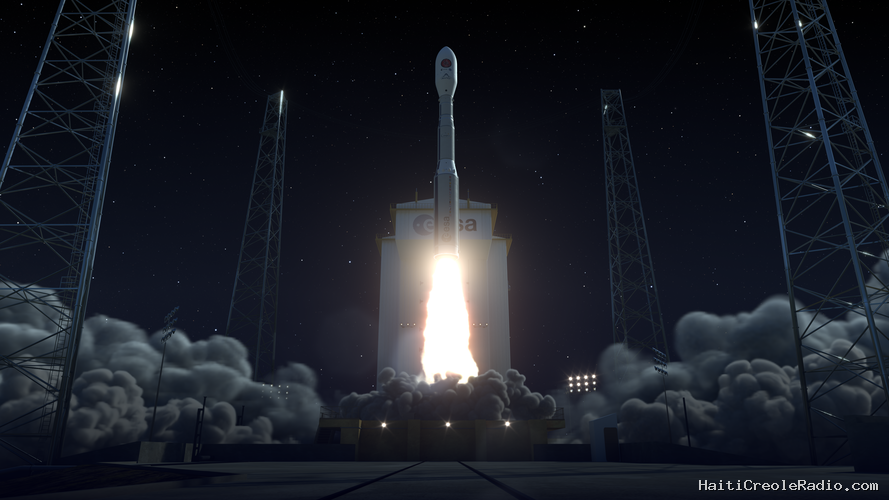
ESA will be broadcasting live as the European-Chinese Smile mission launches at 04:52 BST/05:52 CEST (00:52 local time) on 19 May 2026.
Smile will launch on a European Vega-C rocket from Europe’s Spaceport in French Guiana.
Times subject to change at short notice.
Watch live from 05:30 CEST on 19 May
Tune into ESA Web TV directly or via the ESA YouTube livestream to follow the launch live.
The launch programme will run from 05:30–07:09 CEST. Milestones include:
| Event | Time after liftoff | Time in CEST |
| Liftoff, first stage ignition | 00:00 | 05:52 |
| First stage expends all its fuel and separates | 00:02 | 05:54 |
| Second stage ignition | 00:02 | 05:54 |
| Second stage expends all its fuel and separates | 00:04 | 05:56 |
| Third stage ignition | 00:04 | 05:56 |
| Fairing opens revealing Smile to the sky | 00:04 | 05:56 |
| Third stage expends all its fuel and separates | 00:07 | 05:59 |
| First ignition of upper stage | 00:20 | 06:12 |
| End of first upper stage boost | 00:24 | 06:16 |
| Second upper stage boost starts | 00:52 | 06:44 |
| End of second upper stage boost | 00:54 | 06:46 |
| Smile separates from Vega-C and flies free | 00:56 | 06:48 |
| Expected time of acquisition of Smile’s first signal from space | 00:57 | 06:49 |
| Expected time of deployment of Smile’s solar arrays | 01:03 | 06:55 |
| Third upper stage boost to deorbit | 02:00 | 07:52 |
| End of third upper stage boost. Vega-C mission complete | 02:01 | 07:53 |


Access the video
Press release
An ESA press release will be issued when it is confirmed that Smile’s solar arrays have successfully deployed, which is expected to happen at 06:55 CEST. The press release will be available via the ESA Newsroom and esa.int/Smile.
Join the conversation and #AskESA on social media
Start asking your questions now via @science.esa.int (Bluesky) and @esascience (X) using #askESA.
Follow @science.esa.int and @transport.esa.int (Bluesky) and @esascience and @ESA_transport (X) for detailed live coverage of the Smile launch.
Follow the most important milestones and ESA more generally on: Bluesky: @esa.int X: @ESA Instagram: Europeanspaceagency TikTok: europeanspaceagency YouTube: ESA Facebook: EuropeanSpaceAgencyLinkedIn: European Space Agency - ESA

Access the video
Beyond launch day
After the Vega-C rocket drops Smile off in a circular orbit 700 km above Earth’s surface, the spacecraft will fire its engines 11 times in 25 days.
These engine burns will gradually elongate Smile’s orbit around Earth’s poles, until it is reaching 121 000 km above the North Pole and 5000 km above the South Pole.
Once Smile has arrived in this final operational orbit, the mission team will prepare the spacecraft for science. As well as checking that everything works as planned, this involves remotely unfolding Smile’s magnetometer boom, opening the shutter of its X-ray camera and opening the cover of its ultraviolet camera.
About three months after launch, the team will receive the first X-ray and ultraviolet images, and then finally begin the science that Smile is designed to do. The planned mission lifetime is three years.
Stay updated via esa.int/Smile.

Access the video
About Smile
Smile (the Solar wind Magnetosphere Ionosphere Link Explorer) is a joint mission between the European Space Agency (ESA) and the Chinese Academy of Sciences (CAS).
Smile will use four science instruments to study how Earth responds to the solar wind from the Sun. In doing so, Smile will improve our understanding of solar storms, geomagnetic storms and the science of space weather.
ESA is responsible for providing Smile’s payload module (which carries three of the four science instruments), one of the spacecraft’s four science instruments (the soft X-ray imager, SXI), the launcher, and the Assembly Integration and Testing facilities and services. ESA contributes to a second science instrument (the ultraviolet imager, UVI) and the mission operations once Smile is in orbit.
CAS provides the other three science instruments and the spacecraft platform, and is responsible for operating the spacecraft in orbit.
Smile is part of ESA's Cosmic Vision programme, principally contributing to answering the question ‘How does the Solar System work?’
For more information, visit: https://www.esa.int/Science_Exploration/Smile
About Vega-C
Europe’s Vega-C rocket can launch 2300 kg into space, such as small scientific and Earth observation spacecraft. At 35 m tall, Vega-C weighs 210 tonnes on the launch pad and reaches orbit with three solid-propellant-powered stages before the fourth liquid-propellant stage takes over for precise placement of satellites into their desired orbit around Earth.
Complementing the Ariane family to launch all types of payloads into their desired orbits, Vega-C ensures that Europe has versatile and independent access to space. ESA leads the Vega-C programme, working with Avio as prime contractor and design authority.
For more information, visit: https://www.esa.int/Enabling_Support/Space_Transportation/Vega/Vega-C



Commentaires (0)
Laisser un commentaire
Aucun commentaire. Soyez le premier !