
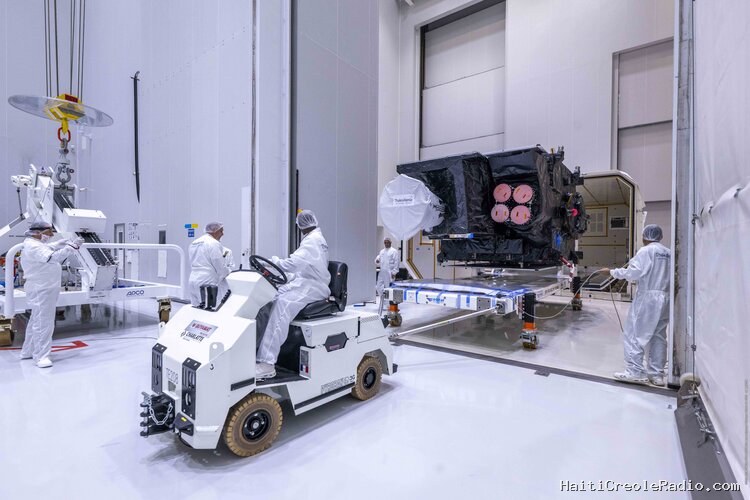
The second Meteosat Third Generation Imager satellite (MTG-I2) has begun its launch campaign, during which it will go through final inspections before being fitted inside the fairing of the Ariane 6 rocket that will launch it into space towards the end of the summer. So how will this 3800 kg satellite help improve weather forecasts for Europe and North Africa?
MTG-I2 was taken out of its protective casing at Europe’s Spaceport in French Guiana yesterday and the teams on the ground are ready to begin the weeks of testing and inspection leading up to launch.
The preparatory activities will include ‘health’ checks to ensure the satellite’s electrical and mechanical systems are working optimally after its long journey across the Atlantic Ocean. These checks also include a series of detailed inspections to ensure the satellite passes cleanliness tests. Then the satellite battery will be charged and the propellant tanks filled before attaching it to the launch vehicle adapter. Finally, the satellite and its adapter will be ‘encapsulated’, or firmly fitted, inside the fairing (upper module) of the Ariane 6 rocket, ready for launch.
Each of these steps will be undertaken with the same meticulousness and teamwork that have characterised the past 15 years – the time it has taken to develop one of the most advanced sets of remote-sensing weather satellites to be placed in geostationary orbit.
MTG-I2 unboxed
This is the first time the team saw the satellite since it left Europe. James Champion, ESA’s MTG Project Manager, said, “It has taken more than 15 years of extremely hard work to create the systems and technology for this next-generation satellite. We’ve worked on technology that didn’t previously exist, including the all-important detectors and their coolers used on both the Sounder and Imager MTG satellites, as well as special materials that absorb vibrations to ensure stability in space. As a team, we are all very proud of what has been achieved so far and the thought that this high-performance satellite will contribute to more accurate and reliable forecasts that will benefit everyone in Europe and North Africa, is a huge motivating factor.”
MTG-I2, the third satellite for the MTG mission, will complete the first family of MTG satellites. From 2033, the second batch of MTG satellites will be launched in sequence to extend the mission’s duration. The MTG family currently has two satellites in orbit, both of which have been fully commissioned and handed over to Eumetsat for operational service. The MTG satellites continue the services previously provided by the four Meteosat Second Generation (MSG) satellites, which were placed in orbit between 2002 and 2015.
MTG to boost forecasting accuracy for Europe’s weather
So how will MTG-I2 improve data for weather forecasts in Europe and in North Africa? The answer is simple: with two of the most powerful and impressive imaging instruments ever to be placed in geostationary orbit. This is an orbit that is sometimes compared to a ‘hawk’s eye’ position because the satellites follow the same point on Earth’s surface as it rotates, observing detail from a great distance of 36 000 km.
One of the instruments is the Flexible Combined Imager (FCI), which provides a rapid scanning service every 2.5 minutes over Europe. Both the MTG-I satellites carry an FCI on board. The first MTG-I is in orbit at zero degrees longitude (in line with London in the UK). MTG-I2 will be positioned at 9.5 degrees East (from a position in line with Germany and Sardinia). Both satellites are focused on Europe and, together, they will provide forecasting data for Europe and North Africa. But it is the rapid scanning service, providing data on a repeat cycle every 150 seconds, that will be the game-changer in terms of weather forecasting. This service will come into effect once Eumetsat, with the support of ESA and the industrial teams, has completed the commissioning of both the MTG-I2 satellite and its ground segment in 2027.
As well as providing a huge increase in the quality, quantity and frequency of data for European weather forecasting, the Flexible Combined Imager also senses data about climate. It provides precise information about Earth’s atmosphere and surface environments, from clouds to water vapour, and from oceans to local fires.
The other instrument on board MTG-I2 is the Lightning Imager. This too, is an innovative and powerful instrument, able to capture individual lightning events, by day and night. When it was launched on the first MTG-I in 2022, it was the first of its kind in Europe. The Lightning Imager carried on MTG-I2 provides exactly the same capabilities and can be used for very accurate, short-term forecasting of rapidly evolving weather conditions. The more frequent data acquisitions enable forecasters to model weather just hours ahead, sometimes referred to as ‘nowcasting’.
Another innovative product that will be possible once all three of the MTG satellites are in orbit is the weather cube, which will combine data from both the Imager and Sounder satellites to create three-dimensional representations of lightning, winds, internal clouds dynamics and other atmospheric gases, including greenhouse gases and air pollutants.
Weather forecasters, climate scientists and researchers benefit from the advanced data and images provided by the Meteosat series of satellites and MTG is designed to extend that legacy. The constellation also provides key information and imagery for monitoring hydrology, agriculture, environmental studies as well as risk prevention and disaster warnings.
Partnerships for space
All three of the MTG satellites have been developed by ESA and built by a large consortium of European industries led by Thales Alenia Space with main partners OHB System in Germany and Leonardo in Italy. Eumetsat operates the satellites once in orbit and disseminates the scientific data.
ESA’s Director of Earth Observation Programmes, Simonetta Cheli, said, “The ESA team has worked tirelessly to develop the innovative MTG mission, which will enhance our understanding of Earth’s climate and weather systems, building on the legacy of the Meteosat series of satellites. The improved quality and frequency of information will bring us better risk warnings ahead of cases of extreme weather, and this should benefit the citizens and help services that protect our communities and infrastructure. We look forward to the next steps and to the continuation of ESA’s excellent contributions together with its European partners.”
Looking ahead
The next steps for the MTG-I2 satellite? Now that the spacecraft with its instruments has been unboxed, it will undergo a series of checks over the next few weeks. Launch is scheduled for August 2026, with a date to be announced within the next few weeks.
This will be the ninth launch of Europe’s heavy-lift rocket Ariane 6. For the August launch, Ariane 6 will be configured with two P120C-based solid-propellant rocket motors to launch MTG-I2 to a geostationary transfer orbit. This will be the first mission to this destination for Ariane 6 and the farthest the rocket will have flown so far. ESA manages the Ariane 6 development programme, ensuring autonomous access to space for the benefit of European citizens. Arianespace is the launch service provider for this flight, VA270.
MTG-Imager mission kit
Find more information about the MTG mission, the instruments on board and the upcoming launch, in the MTG-Imager mission kit.



Commentaires (0)
Laisser un commentaire
Aucun commentaire. Soyez le premier !