
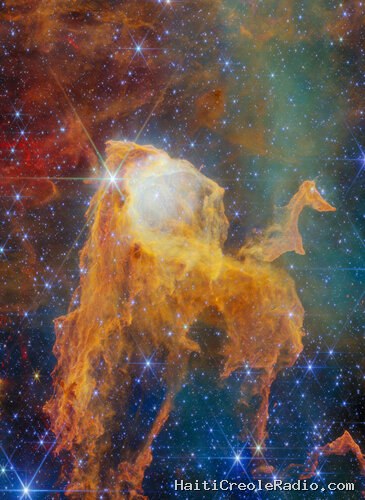
This NASA/ESA/CSA James Webb Space Telescope Picture of the Month takes us to a fantastical realm within our home galaxy, where piercing starlight and billowing winds sculpt dust clouds into inventive shapes. This scene is from the Carina Nebula, which lies just 7500 light-years away in the constellation Carina (the Keel).
Spanning roughly 260 light-years, the nebula is home to an incredible collection of objects, including the Cosmic Cliffs revealed in the first-ever Webb image release. The Carina Nebula is also the nearest high-mass star-forming region that allows astronomers to study the full range of star formation. This nebula houses some of the most massive stars in our galaxy as well as tens of thousands of protostars, offering a valuable opportunity to understand how stars shape their neighbourhoods.
The feature highlighted in today’s image, aptly called the Treasure Chest, looks right at home in this celestial sculpture garden. The Treasure Chest is what’s known as a cometary globule. A cometary globule is an isolated cloud of gas and dust with a dense, dark head and a sweeping tail. These clouds often somewhat resemble comets, but the Treasure Chest looks distinctly like a wooden chest with its lid wide open.
However, this chest doesn’t contain jewels or gold coins, but instead a compact cluster of young stars. These stars are responsible for the otherworldly glow coming from within the Treasure Chest, revealed by Webb’s sensitive Near-Infrared Camera (NIRCam). Researchers estimate that the Treasure Chest’s cluster contains about 70 stars, the most massive of which is a rare O-type star roughly 19 times as massive as the Sun.
The star cluster is likely around 1.3 million years old, though earlier estimates found it to be as young as just 100 000 years old. Because of its youth, the cluster is still deeply embedded within the dusty clouds of the Treasure Chest. The individual stars in the cluster are wrapped up in dust as well; astronomers have found evidence that many of these stars are surrounded by circumstellar discs. Over time, the brilliant starlight from these young stars will dissipate the surrounding cloud and reveal the entire cluster.
The key to the Treasure Chest’s sculptural shape lies outside this image: just 39 light-years to the northwest, as measured on the sky, sits Eta Carinae, the most luminous object in the entire Carina Nebula. Eta Carinae is a star system containing at least two stars, one of which is 100 times as massive as the Sun. This star alone is about 5 million times as luminous as the Sun. Adding to this intense radiation is the nearby star cluster Trumpler 16, which also contains several extremely hot massive stars.
With Webb, astronomers have carried out an observing programme (#5408; PI: Reiter) dedicated to studying how young stars in the Carina Nebula collect gas from their surroundings and expel it through outflows.
[Image Description: A region of space filled with bright stars and clouds of gas. In the centre, the densest clouds form the shape of a chest with its lid open. The chest appears to glow from within. At its base it breaks apart into long pillars of thick gas. Many of the gas clouds in the background are dark orange globules, while others form large, pale hazes. A few brightly shining stars lie in the foreground, the biggest and brightest in front of the chest’s lid.]

Commentaires (0)
Laisser un commentaire
Aucun commentaire. Soyez le premier !