
As we prepare to return to the Moon, Europe’s leading geology training for astronauts PANGAEA celebrates its 10th anniversary turning extraordinary places on Earth into classrooms for space exploration.
ESA astronaut Pablo Álvarez Fernández, NASA astronaut Jasmin Moghbeli and Kimiya Yui from the Japanese space agency took part in PANGAEA’s 10th edition.
The astronauts learned to identify Moon and Mars rocks, interpret their origin and understand the history behind them. Together, they embarked on a science journey that grew in complexity as the crew faced exploration challenges in real environments.
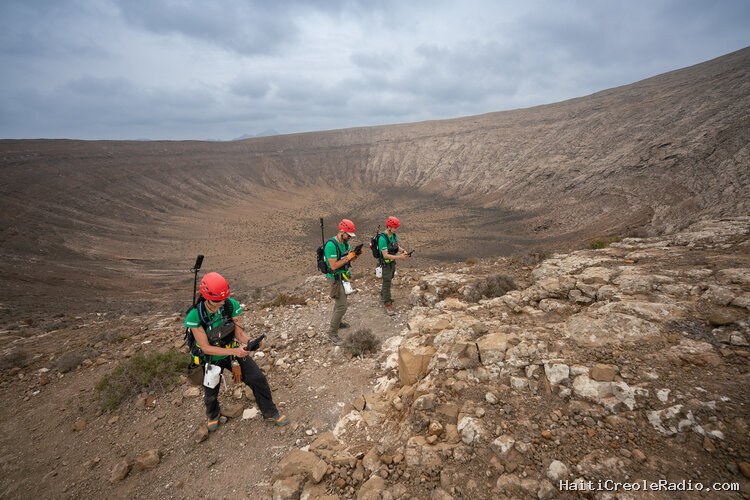
Over three intensive weeks, the training took the astronauts from theory-packed lessons to the wild outdoors across Europe, including the Bletterbach canyon in Italy, the Ries crater in Germany and the volcanic landscapes of Lanzarote in Spain.
This edition was dedicated to Riccardo Pozzobon, a PANGAEA instructor who passed away one year ago while taking part in a scientific expedition in Alaska.
“This year we covered a full working cycle, from training individual skills to a deliberate transition to crew operations. Before heading into the field, the astronauts had to make a plan with the scientists, and afterwards they reviewed the geological results together,” explains Loredana Bessone, PANGAEA’s project lead.
Space explorers must do more than recognise an interesting rock. They need to agree on priorities, divide tasks and communicate with the ground, adapting their exploration as the terrain challenges their plans. The course gave Pablo, Jasmin and Kimiya the knowledge, practice and growing independence to make decisions together.
Moon phase
When astronauts are on the Moon, every second will be precious, and every rock will count. There will be limited time to recognise why a lunar sample matters and explain it to scientists on Earth.
“We train astronauts for future missions on the lunar surface. What started as a new astronaut geology course has grown into a programme combining planetary science, field geology, real exploration and crew operations,” says Samuel Payler, PANGAEA deputy project lead.
“Every piece of the Moon we can lay our eyes and hands on is a time capsule and a treasure trove of the history of our Solar System. They are not just rocks. Every sample is critical to completing the puzzle,” explains Katherine Joy, PANGAEA instructor and professor of lunar and planetary science at the University of Manchester.
PANGAEA is currently part of the training prerequisites for Artemis Moon missions. Since 2016, the programme has provided 19 astronauts from four space agencies with a comprehensive set of geology skills and lunar lessons.
The PANGAEA effect
In the field and in the classroom, astronauts learned to interpret the terrain they explored, document their findings and work in coordination with science teams on the ground. Instructors also wanted the crew to share a common language with the scientists who may one day support future missions on another world.
Thanks to lessons combining theory and hands-on exercises, Pablo admitted to experiencing the ‘PANGAEA effect’: a geological filter that changes how one sees the world and reads the geological stories written in stone.
“We became the eyes and hands of scientists in space, speaking their language and understanding how to find relevant samples,” says Pablo.
In Italy’s Bletterbach canyon, they learned to describe rock layers and reconstruct environments that existed millions of years ago.
At Germany’s Ries crater, they studied the evidence left by an asteroid impact and applied their growing knowledge to the Moon’s cratered surface.
The final week in Spain’s Lanzarote changed the balance of the training, where the astronauts spent more time on field traverses, making their own observations and decisions while a science team supported them remotely.
During the training, the astronauts built up skills that one day might help unlock unanswered questions about the history of Earth, the Moon and Mars.
“I hope that one day I will have the opportunity to apply all this knowledge on a space mission, to use my geologist’s eyes and bring back the rocks scientists dream of,” says Pablo.


Commentaires (0)
Laisser un commentaire
Aucun commentaire. Soyez le premier !