
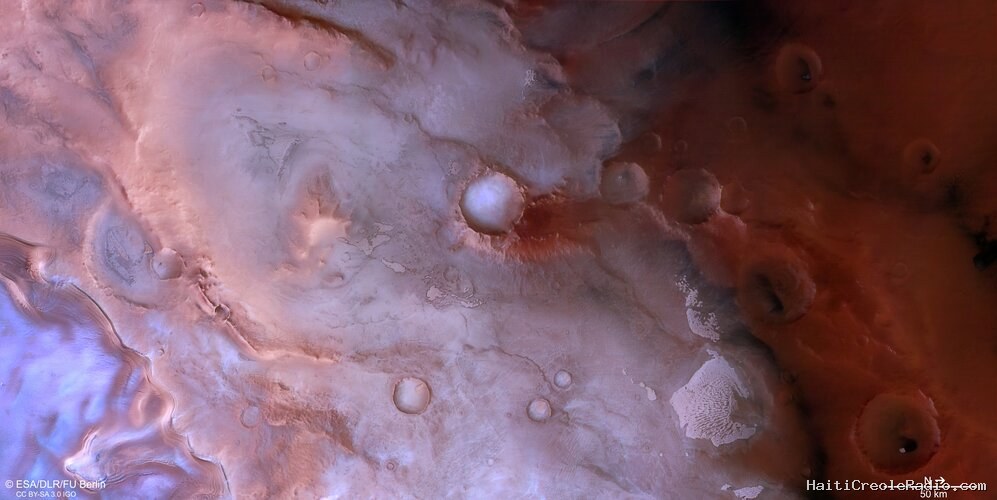
This image shows a prominent ice cliff near Mars’s south pole. With striking swirls of purple, pink and red, it’s a far cry from the colour palette we usually associate with the Red Planet.
We’re used to seeing pictures of Mars that are very different in colour to this berry-toned view, featuring tans, ochres, reds and browns – all caused by high levels of oxidised iron. But the planet is rich in other hues, as shown beautifully in this new image from the European Space Agency’s Mars Express.
Taken by the spacecraft’s High Resolution Stereo Camera (HRSC), this image shows an icy, craggy feature known as Thyles Rupes (‘rupes’ being latin for cliff and ‘Thyles’ referring to ‘Thule’, a legendary place beyond the edge of the known world in classical geography). Its beautiful colours are obvious – but what causes them?
The darker tones are due to material that has been both made and spread by volcanoes, which leaves it rich in ‘mafic’ minerals such as olivine and pyroxene (both of which are prevalent in Earth’s mantle, the layer of rock sitting just below our planet’s crust).
The images below show 3D close-ups of different parts of the main image above. Text continues after the images.
Paler areas are covered by frosty deposits of carbon dioxide, which persist here even during martian spring (when this region was imaged). These blueish deposits can be seen atop sand dunes and within craters. Part of a glacier, itself part of Mars’s South Polar ice cap, can be seen to the bottom left of the frame as a pale patch of ice.
The general berry-purple hue of this scene is due to a mix of light, dust, and frost. Mars’s atmosphere is highly variable over time, meaning that images often show up in different colours throughout the day. The soft and rosy morning light here, combined with dust hanging in the air, a general ground cover of frost, and patches of mixed-up ice and dust scattered across the terrain, all come together to cause the striking purple tones we see.
The image below is an elevation map of the main image, showing different surface heights in different colours. Text continues after image.
The icy region at the bottom left is a mound – a patch of high elevation (see the topographic map, above). If it doesn’t look that way to you, instead appearing as a dip in the surface, it may be because the light is coming from a different direction to the one our eyes ‘expect’. The sunlight is coming from the bottom of the image (the east), as shown by the shadows across the scene (see the crater rim at the centre of the image as an example). If you look at the icy region with this in mind, it may ‘fix’ itself – but if not, try flipping the image upside down, and this may help you visualise the topography correctly.
Steep cliffs and frosted dunes
The rocky cliffs of Thyles Rupes can reach towering heights of over 1 km tall in some places. They are thought to be tectonic in nature, meaning that the cliffs formed as two parts of Mars’s crust were pushed together, causing one to rise up above the other. This likely happened as the interior of Mars began to cool, causing it to contract and deforming the planet’s crust above. Some blocks of Mars’s surface would have been pushed upwards via this process, forming steep cliffs – as seen here.
Unlike Earth, present-day Mars lacks active tectonics. While we see the evidence today, the processes once at play here occurred billions of years ago.
Thyles Rupes is found in the region near Mars’s south pole, in the planet’s southern highlands. It extends for hundreds of kilometres, slicing across terrain that’s heavily covered in impact craters. While some of these craters are cut through by the cliffs, indicating that they formed first and that Thyles Rupes came after, others lie on top, indicating the opposite.
Below is another 3D close-up, showing the craters that cut through, and are cut through by, Thyles Rupes.
Different kinds of sand dunes can also be seen here, most prominently in the rippled patches of white visible to the lower-right of centre. Winds blowing from all directions have picked up and carried sand across the martian surface, forming dunes of various shapes and types (including longitudinal and transverse dunes – long, parallel scratches that form parallel to or at right angles to the wind direction, respectively – and sickle-shaped barchanoid ridges).
Decades of Mars exploration
This image comes courtesy of the HRSC camera, one of eight instruments aboard Mars Express. HRSC has shown us Mars in unexpected colours before – a key example being the snapshot released to celebrate 20 years of Mars Express in 2023. Although the colours of the 2023 anniversary picture are enhanced to highlight variation across the martian surface, it shows just how diverse the surface of Mars really is, with dark grey-black volcanic sands bumping up against lighter material rich in clays and sulphates.
Mars Express has been capturing and exploring Mars’s many landscapes since it launched in 2003. The orbiter has mapped the planet’s surface at unprecedented resolution, in colour, and in three dimensions for over two decades now, returning insights that have drastically changed our understanding of our planetary neighbour (read more about Mars Express and its findings here).
The Mars Express HRSC was developed and is operated by the German Aerospace Center (Deutsches Zentrum für Luft- und Raumfahrt; DLR). The systematic processing of the camera data took place at the DLR Institute of Space Research in Berlin-Adlershof. The working group of Planetary Science and Remote Sensing at Freie Universität Berlin used the data to create the image products shown here.



Commentaires (0)
Laisser un commentaire
Aucun commentaire. Soyez le premier !