
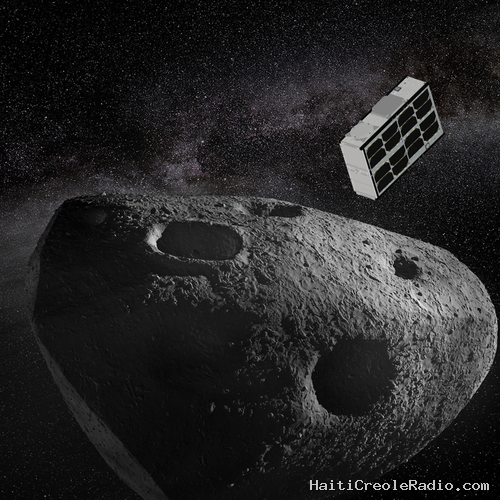
The European Space Agency has contracted Spanish company EMXYS for the first CubeSat designed to operate on the surface of an asteroid. Don Quijote is a shoebox-sized spacecraft that will be deployed onto the Apophis asteroid by ESA’s Ramses mission before the asteroid flies by Earth on 13 April 2029.
“The arrival of Apophis represents a unique opportunity,” said ESA’s programme manager for Mars and Beyond, Orson Sutherland. “It is exceedingly rare for such a large asteroid – at 375 m across, about the size of a cruise liner – to pass so near to Earth. Flying past at an altitude of 32 000 km, its trajectory will take it within the orbit of our geostationary satellites.
“It’s really a free experiment because the tug of Earth’s gravity is forecast to trigger deformation and potentially set off asteroid quakes, that Don Quijote will now be able to monitor right on the spot.”
Ramses mission manager Paolo Martino adds: “Now that also the last main contract has been signed, the team can get on with implementing the mission within an unavoidably tight timescale – because the asteroid will not be waiting around for us!”
Tight deadline for launch
To meet its spring 2028 deadline for launch on a Japanese H3 rocket, the development, integration and testing of Ramses must be completed within less than two years. To help achieve this, Ramses reuses design elements of ESA’s Hera asteroid mission, on track to reach the Dimorphos asteroid this November.
Ramses, like Hera, will also carry a pair of CubeSats – miniature spacecraft built up from 10 cm boxes – for closer observations of its target. Farinella, from Italy’s Tyvak International company, will combine a ground-penetrating radar with a dust analyser.
Don Quijote is being provided by Spain’s EMXYS company, which previously built a gravity-measuring ‘gravimeter’ for Hera’s Juventas CubeSat, which will aim to attempt a landing on the Dimorphos asteroid.
Into the unknown
José A. Carrasco, CEO of EMXYS explains: “We have previously provided CubeSat platforms for low-Earth orbit, but Don Quijote must operate in the much more challenging deep space environment, then proceed to land autonomously onto a strange and largely unknown surface. Once there it has not only to survive but also perform demanding science at the same time, then relaying results back to its Ramses mothership.”
The CubeSat will carry a trio of instruments: a new gravimeter developed by the Royal Observatory of Belgium with EMXYS; a magnetometer from Germany’s Technische Universität Braunschweig to measure if the asteroid has a magnetic field – and how it might change when interacting with Earth’s own magnetic field and gravity – and a seismometer from French aerospace centre ISAE-SUPAERO, to perform the first seismic measurements on an asteroid.
Cramming all of Don Quijote within a space smaller than a desk drawer is also a challenge, adds EMXYS Chief Technology Officer Francisco García de Quirós: “We have to fit in all our instruments, plus the spacecraft electronics, batteries and inter-satellite links, along with eight thrusters for propulsion. At the same time we must maintain a carefully controlled centre of mass so the thrusters work with optimal efficiency as the CubeSat steers itself down to a safe landing.”
Landing, then bouncing?
Francesca Ingiosi, overseeing Ramses’ CubeSats, notes: “There won’t be time for sustained human oversight: Don Quijote is going to take itself down on a completely autonomous basis, relying on feature tracking to find a safe place to land. It will be running its gravimeter and magnetometer when it flies, but we have high expectations for its scientific work on the surface.
“It will come down quite slowly, but in the ultra-low gravity of Apophis some bouncing along the surface is possible. The CubeSat is therefore designed to operate from any orientation, although the precise nature of the surface remains a question mark: there is even a small possibility that Don Quijote sinks into the ground, which would not be good!
“The asteroid is likely to be tumbling chaotically, and passing from local day to night should mean big temperature shifts. To maximise our surface lifetime we would want to be on a spot experiencing both day and night, to allow us to recharge our batteries without overheating. But if we did end up in sustained shadow Don Quijote also has non-rechargeable batteries as a backup power source.”
Both CubeSats are now being built in their respective countries. They will join the Ramses spacecraft in autumn next year, during the mission’s qualification phase at the ESTEC Test Centre in Noordwijk, the Netherlands.


Access the video



Commentaires (0)
Laisser un commentaire
Aucun commentaire. Soyez le premier !