
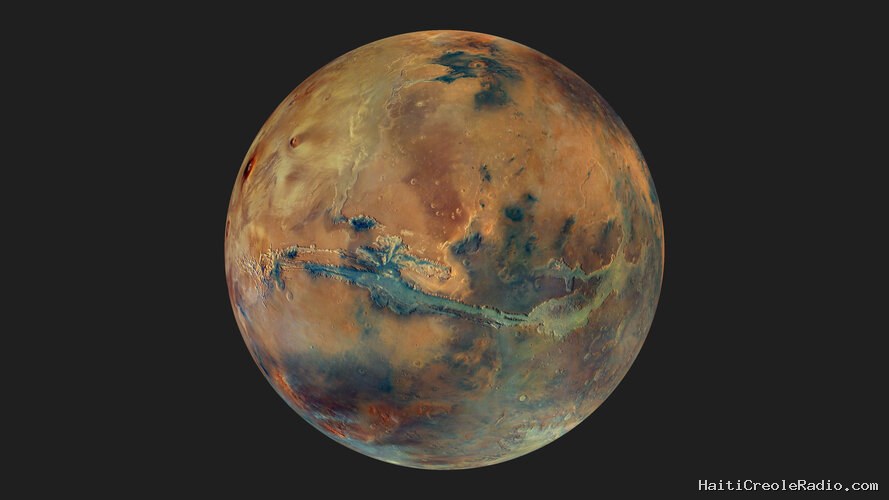
30 September 2026 marks the start of a new year on Mars. At exactly 13:43 CET/11:43 UTC on Earth, the Red Planet begins a new orbit around our Sun.
This is the 38th martian year. The convention for counting years in the martian calendar started in 1955, with the first year coinciding with a major storm named ‘the great dust storm of 1956’.
There are some significant differences between years on the two planets:
- Days: A martian day is called a ‘sol’ and lasts 24 hours and 39 minutes, slightly longer than an Earth day.
- Years: One year on Mars equals 687 Earth days, or 668 sols, nearly twice as long as an Earth year. If you would like to know your martian age, divide your current age by 1.88 and tell your friends how much younger you are… on Mars, at least!
- New Year: The martian New Year begins on the northern equinox (northern spring, southern autumn on Mars).
- Seasons: Like Earth, Mars has four seasons – winter, spring, summer and autumn. Unlike Earth’s seasons, martian seasons are not of equal lengths due to Mars’ more elliptical orbit. The planet’s axial tilt causes the northern hemisphere to receive more sunlight during the northern summer, and the southern hemisphere to receive more sunlight in northern winter. Winter and summer come when the northern and southern hemispheres tilt away from the Sun in turn.
- Dust seasons: The second half of the martian year is often marked by fierce dust storms that can sometimes become planet-wide. As Mars swings closer to the Sun, the atmosphere heats up, causing winds to lift up very fine particles from the martian soil. Once airborne, these brownish particles heat up and redistribute some of that warmth to the surrounding atmosphere. This process can rapidly pump a lot of dust.
- Weather: Temperature swings between day and night are extreme on Mars. At noon on a summer's day, air temperature can reach 0 ºC but will plunge to –60 ºC at night. In winter, night temperatures are even colder, dropping to –110 ºC. A recurring weather phenomenon is the Arsia Mons Elongated Cloud, a cloud of ice crystals that can reach up to 1800 km in length.
Future New Years on Mars
| Mars year | Earth date |
| 40 | 17 August 2028 |
| 41 | 5 July 2030 |
| 42 | 22 May 2032 |
What would be your martian New Year’s resolution? Share your answer on ESA’s X, Facebook and Instagram accounts.
Here are the resolutions from the ESA teams working for Mars exploration. If you need some inspiration, here is a poem Dutch author Marjolijn van Heemstra dedicates to Mars.


A poem for Mars
Access the video
Access the video


Commentaires (0)
Laisser un commentaire
Aucun commentaire. Soyez le premier !