
(Français)
The Pentagon’s Operation Southern Spear burst into the world’s headlines in September 2025 when the U.S. Navy began to bomb small boats in the Caribbean Sea and Pacific Ocean.
While the Trump administration claimed it was stopping narco-traffickers running drugs to the U.S., it is now well established that many (if not almost all) of the victims illegally attacked and extrajudicially killed by the Southern Command’s drones and missiles were innocent fishermen, ferrymen, travelers, or other civilians with no connection to the drug trade.
Some of those wounded in the attacks say they were later arrested and tortured by U.S. forces. “Thirty-six survivors of two Pacific attacks… alleged that they were abducted and tortured by American forces and taken by boat all the way to El Salvador before being returned to Ecuador,” thanks only to the efforts of the families, reported Drop Site News in an in-depth Apr. 21 exposé.

Due to their small size, none of the vessels blown up had even a remote chance of reaching U.S. shores.
As of this writing, since Sep. 2, 2025, the U.S. has carried out 55 strikes, 17 in the Caribbean and at least 36 in the Pacific, destroying 56 boats and wrongfully killing at least 188 civilians, according to a regularly updated blog kept by the Center for Economic and Policy Research (CEPR) in Washington, DC.
Haiti Also in the Cross-hairs
The first time Operation Southern Spear targeted Haiti was on Feb. 3, 2026, when U.S. warships – the USS Stockdale, USCGC Stone, and USCGC Diligence – cruised into the Bay of Port-au-Prince to send a message to all Haitians that Washington wanted no renewal of the Transitional Presidential Council (CPT), whose mandate was to expire on Feb. 7, and that de facto Prime Minister Alix Didier Fils-Aimé alone would assume all executive power.
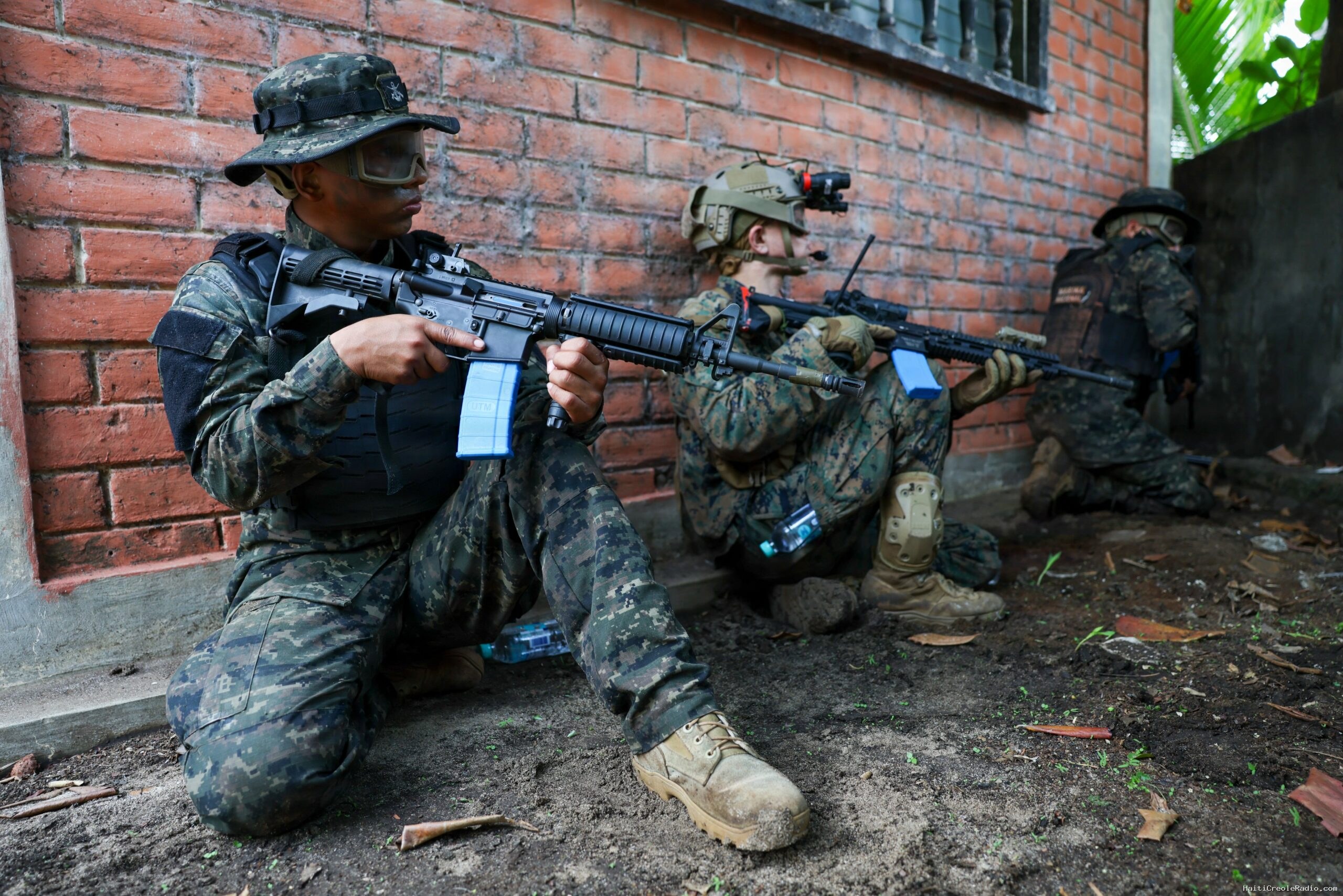
But in the last three months, the Pentagon has begun to deploy its forces increasingly on land rather than sea.
Washington’s first step is to have its State Department create “designated terrorist organizations,” which becomes the justification for unilateral military action. For instance, in Ecuador, now gripped by the iron-fist of close-Trump-ally President Daniel Noboa, the “designated terrorists” are suspected drug traffickers. On Mar. 3, “U.S. Special Operations [assisted] in raids by elite Ecuadorian forces on suspected drug cartel ‘processing and shipping’ facilities” in Ecuador, reported The Intercept on Mar. 4.
“This was always going to escalate,” an anonymous U.S. government official told The Intercept, referring to Operation Southern Spear “It wasn’t going to be just boat strikes forever.”
Coming Ashore
Just like Haiti, Ecuador has a constitutional ban on the deployment of foreign troops on its soil. In November 2025, 60% of Ecuadorians voted to uphold this ban, which dates back to the anti-imperialist government of Rafael Correa in 2007. Trump recently publicly acknowledged his disregard for international law, declaring: “we’re like pirates.”

Knowing Haitians’ nationalist disposition, the U.S. has taken a more sneaky approach in Haiti. First, since November 2024, the Federal Aviation Administration (FAA) has prohibited all commercial airlines leaving U.S. airspace from flying to Port-au-Prince’s Toussaint Louverture International Airport, which historically has been the principal international gateway into Haiti. This ban has been copied by Canada, France, and the Dominican Republic.
PAP’s closure has caused great suffering and distress to Haitians. Those in the diaspora wishing to visit their country must travel at great expense either through the much smaller Cap Haïtien airport in Haiti’s north or the Dominican Republic.
In response, there is today a nationwide movement in Haiti to re-open the airport. “One of this mobilization’s key demands is that the capital’s airport must under no circumstances be transformed into an American military base,” wrote Berthony Dupont in an Apr. 22 Haïti Liberté editorial. “We cannot force any nation to maintain commercial relations or any other form of interaction with us; conversely, they cannot violate our rights by closing our airport as they wish, even going so far as to intimidate or prevent other nations from landing there.”
On May 1st, International Workers Day, hundreds of Haitians marched and demonstrated in Port-au-Prince to demand the airport’s reopening. Fils-Aimé seemed to mock Haitians when he began to chant and head bob along with demonstrators shouting at him “Unblock the nation” and “Open the airport.” His jocular response was a faux pas because it echoed a similar one by his political predecessor, President René Préval, who two decades earlier had infamously and cavalierly said, when faced with an angry crowd demanding that he take action: “When you next demonstrate, stop by the Palace to get me, I will join you.”
But the Port-au-Prince airport has, in fact, been converted into a de facto U.S. military base where the troops of the U.S.-sponsored and financed “Gang Suppression Force” (GSF), like the “Multinational Security Support” (MSS) before it, are garrisoned. U.S. military planes are regularly seen landing there.

U.S. control of the airport seemed to be confirmed this week when, on Radio Télé Éclair’s Micro Vérité (Truth Microphone), an anonymous Haitian National Police (PNH) officer said that the U.S. Embassy had instructed the Haitian government and police brass not to allow Haitians to demonstrate at the airport.
Designating Viv Ansanm as Terrorist
On May 2, 2025, U.S. Secretary of State Marco Rubio declared the Viv Ansanm (Live Together) coalition of armed neighborhood groups in greater Port-au-Prince a “designated terrorist organization,” thereby laying the ground for another U.S. military intervention.
Exactly one year later, on May 2, 2026, “as part of Operation Southern Spear, a contingent of American military personnel reportedly landed in Ouanaminthe, Haiti, at noon,” reported Haitilibre.com. A helicopter “is said to have landed at the Haitian customs heliport, carrying American soldiers accompanied by [PNH officers]… According to available (unofficial) information, the priority missions of the American contingent deployed in Ouanaminthe are to combat narco-terrorism, prevent gangs from retreating to the Dominican Republic, and stop arms smuggling.”
So it now appears that the U.S. has stationed Operation Southern Spear contingents in both Ouanaminthe and Port-au-Prince.
The U.S. Southern Command did not reply to Haïti Liberté’s request for confirmation.
As for the objective of preventing “gangs” from “retreating to the Dominican Republic,” guarding the northeastern border crossing between Ouanaminthe and Dajabón does not make much sense. None of the Viv Ansanm or Artibonite Valley armed groups have a presence in Haiti’s North or Northeast Departments. Furthermore, the DR now has a highly monitored and militarized border with Haiti, particularly around Dajabón.
Despite a disastrous and deteriorating situation with its war against Iran and a looming planetary economic crisis, the U.S. is planning its Operation Southern Spear until at least 2028, according to The Intercept.
“Mark Cancian, an analyst with the Center for Strategic and International Studies, told The Intercept that the documents suggest the outsized American military presence in the Caribbean could continue for years,” the outlet wrote.
The last time that the U.S. military set up long-term bases in Haiti was 1915, when U.S. Marines invaded for the first time, remaining for 29 years, until 1934. U.S. military interventions in 1994 and 2004 only remained in Haiti for about three months, before passing off their occupation to more cheaply paid UN troops.
Interdicting Marijuana
Meanwhile, the U.S. has set a very low bar for the drugs it is interdicting in the Caribbean. On Apr. 30, the U.S. Navy’s USS Billings combat ship, with a U.S. Coast Guard Tactical Law Enforcement Team aboard, “stopped a suspected drug smuggling vessel” in the Windward Passage “approximately 8 miles off Mole Saint-Nicolas, Haiti” (i.e. within the 12 nautical miles of Haiti’s territorial waters), according to a Coast Guard press release. “With the permission of the Haitian government, the boarding team’s investigation resulted in approximately 3,200 pounds of marijuana being found, worth approximately $3.8 million, and one person was detained. The contraband and suspected smuggler were transferred to Haitian authorities, Sunday,” May 3.
The U.S. Coast Guard turned over “a Jamaican citizen, Aldane Anderson, alias ‘Ali,’ born Jan. 26, 2001,” to the PNH’s Drug Trafficking Brigade (BLTS/North) in Cap Haïtien, Icihaiti.com reported, along with “66 bags of marijuana, carefully wrapped in plastic.” It is not clear why or where Anderson was held by the Coast Guard for three days.

Marijuana is legal in 40 out of 50 U.S. states, although it is still technically illegal under federal law. Along with hemp, marijuana is illegal in Haiti.
Ironically, nowhere did the U.S. Southern Command assert that the USS Billings was part of Operation Southern Spear, whose real purpose is not drug interdiction, but rather regime change (in Venezuela and Cuba), counter-insurgency (in Haiti), and U.S. military and political domination of the entire region.
Only time will tell if the U.S. has overestimated its power and underestimated popular resistance to it in the Caribbean just as it has so dramatically done in its spiraling debacle in Iran.


Commentaires (0)
Laisser un commentaire
Aucun commentaire. Soyez le premier !