
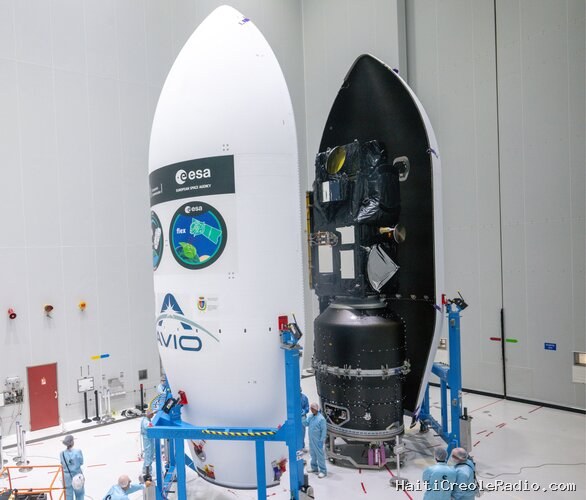
At Europe’s Spaceport in French Guiana, preparations for one of the year’s most anticipated Earth-observation launches are entering their final stages.
FLEX and Copernicus Sentinel-3C have now been enclosed within the protective fairing of their Vega-C rocket, bringing the two satellites one step closer to their shared journey into space.
Liftoff is scheduled for 15 September at 03:21 CEST (14 September at 22:21 local time).
After more than six weeks of preparations at the spaceport, encapsulation marks a significant transition in the launch campaign.
It is also a poignant moment for the teams who have spent years designing, building, testing and preparing the satellites for their life in orbit.
FLEX was first encapsulated within the lower part of the Vespa secondary payload adapter – a system that allows the rocket to carry multiple satellites on a single launch. Sentinel-3C was then mated to the upper part of Vespa.
The entire process was delicate and critical, requiring careful handling and great precision. This positioning allows Sentinel-3C to be deployed first.
With both satellites securely in position, the two halves of the Vega-C rocket’s fairing were brought together and sealed.
While FLEX benefits from the additional protection provided by Vespa, the rocket’s fairing forms a protective shell around the entire payload stack.
It shields the satellites from the deafening acoustic environment, intense vibrations and aerodynamic forces generated during launch, as Vega-C accelerates through Earth’s atmosphere and into space.
Beneath that protective shell are two satellites with distinct missions but a common goal: building a more detailed picture of our changing planet.
Sensing the invisible glow of vegetationFLEX – the Fluorescence Explorer – is ESA’s next Earth Explorer mission and is designed to reveal a phenomenon invisible to the human eye: the faint fluorescence emitted by plants as they photosynthesise.


Access the video
Equipped with a Fluorescence Imaging Spectrometer, FLEX will detect and measure this incredibly weak signal from orbit. Because the fluorescence varies with plant health and environmental conditions, the measurements will provide scientists with new information about photosynthetic activity and vegetation stress on a global scale.
The mission is expected to produce global maps of vegetation fluorescence at a resolution of 300 × 300 metres, offering a new way to study how plants interact with the atmosphere and how carbon and water move through Earth’s ecosystems.
Sentinel-3C keeps watch over EarthCopernicus Sentinel-3C, the third satellite in the Sentinel-3 series. Sentinel-3C will continue the systematic monitoring of Earth’s oceans, land, ice and atmosphere.
Its suite of instruments will measure parameters including sea-surface temperature, ocean colour, sea level and sea-ice characteristics.
Altimetry, temperature and colour observations will also support the monitoring of vegetation, wildfires, and variation in the height of inland waters and ice sheets.
Sentinel-3 mission data support the Copernicus Services and help understand Earth dynamics.
Next stepsThe next major step will see the encapsulated fairing carefully hoisted into position atop the Vega-C rocket at the launch pad, bringing the mission another step closer to liftoff.
Europe’s Vega-C can launch 2300 kg into space. It weighs 210 tonnes on the launch pad and reaches orbit with three solid-propellant-powered stages before the fourth liquid-propellant stage takes over for precise placement of satellites into their desired orbit around Earth.
Complementing the Ariane family, Vega-C ensures that Europe has versatile and independent access to space.
ESA leads the Vega-C programme, working with Avio as prime contractor and design authority. For this launch Avio is also launch service operator.


Commentaires (0)
Laisser un commentaire
Aucun commentaire. Soyez le premier !