
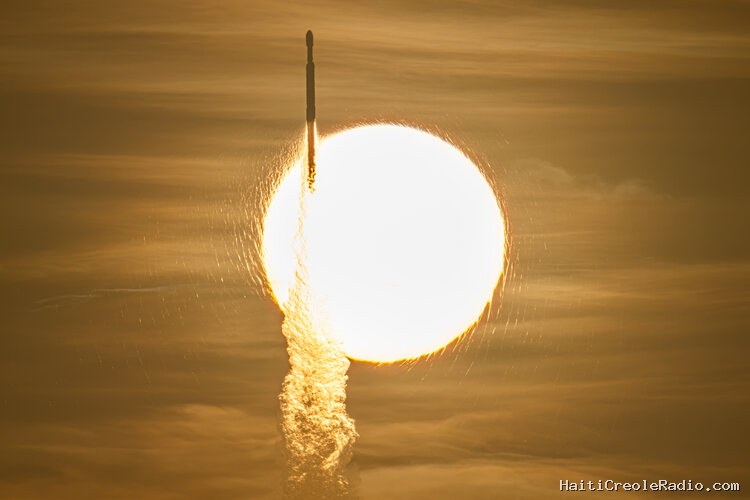
NASA’s Nancy Grace Roman Space Telescope lifted off on a SpaceX Falcon Heavy rocket from NASA’s Kennedy Space Center in Florida, USA, at 07:26 EDT / 12:26 BST/ 13:26 CEST on 30 August 2026. With the successful launch, Roman began its mission to survey the sky in visible to near-infrared light to help reveal the nature of dark energy and dark matter. The telescope will also investigate the true diversity of exoplanets in our galaxy.
Roman is a NASA-led mission to which the European Space Agency (ESA) contributed star trackers, batteries, and detectors for the coronagraph instrument. ESA will also provide communications support through its deep-space ground station network, and enable data download using its new 35-metre antenna in New Norcia, Australia.
“I warmly congratulate our colleagues at NASA on the successful launch of Roman,” says Carole Mundell, ESA’s Director of Science. “ESA is proud to have provided essential hardware and to continue supporting Roman’s ambitious scientific goals. Together, we are opening new windows on the cosmos.”
Like ESA’s Euclid space telescope, Roman will enable astronomers to study the Universe in unprecedented detail. It is equipped with a primary mirror of 2.4 m and two instruments: the Wide Field Instrument (WFI) and a Coronagraph Instrument technology demonstration.
With its panoramic view of the sky, crisp infrared vision and quick re-orientation skills, Roman will perform fast and efficient surveys of a large area of the sky. By doing so, it will map clustering of galaxies over time and space and also study the light coming from thousands of distant type Ia supernovas which will help astronomers trace the expansion of the Universe.
“Roman should provide our clearest picture yet of whether dark energy is truly constant or whether it evolves over cosmic time – either outcome would have profound implications for our understanding of the Universe. I'm also excited by Roman's exoplanet census, which will discover thousands of new worlds, including cold planets and free-floating planets that have remained largely beyond our reach until now,” says Bethan James, ESA’s Roman Project Scientist. “Perhaps what excites me most is the unexpected. With its unprecedented combination of depth, area, and image quality, Roman has every opportunity to surprise us.”
After launch, Roman is on a steady course to the second Sun-Earth Lagrange point (L2), nearly 1.5 million km away from Earth. This location allows the telescope to have an unobstructed view of a wide area of the sky, almost 12%. Like ESA’s Euclid and the NASA/ESA/CSA James Webb Space Telescope, Roman will move in a wider orbit around the L2 point – much larger than the Moon’s orbit around Earth.
In the next three months following launch, the Roman team will conduct a carefully orchestrated series of deployments, calibrations, and tests. Once the commissioning period is complete, the mission will begin its science operations, starting with the first science image release. Roman will spend at least five years scanning the infrared sky and is designed to work in space for another five years.
[Image description: A SpaceX Falcon Heavy rocket with NASA’s Nancy Grace Roman Space Telescope on board is seen transiting the Sun during launch from Launch Complex 39A, on Sunday 30 August 2026, at NASA’s Kennedy Space Center in Florida, US.]



Commentaires (0)
Laisser un commentaire
Aucun commentaire. Soyez le premier !